
Stand in front of a mirror, smile, and then let your face settle again. If people comment on your smile first, or lipstick seems to travel further across your face than it does on other people, width may be the reason. That impression is useful, but it is not a measurement.
Many people with a wide mouth describe their lips as thin, even when the height of their lips is completely average. The two traits measure different things, and mixing them up leads to makeup advice that does not fit. This guide separates width from fullness, so you can name what you actually have.
Quick answer
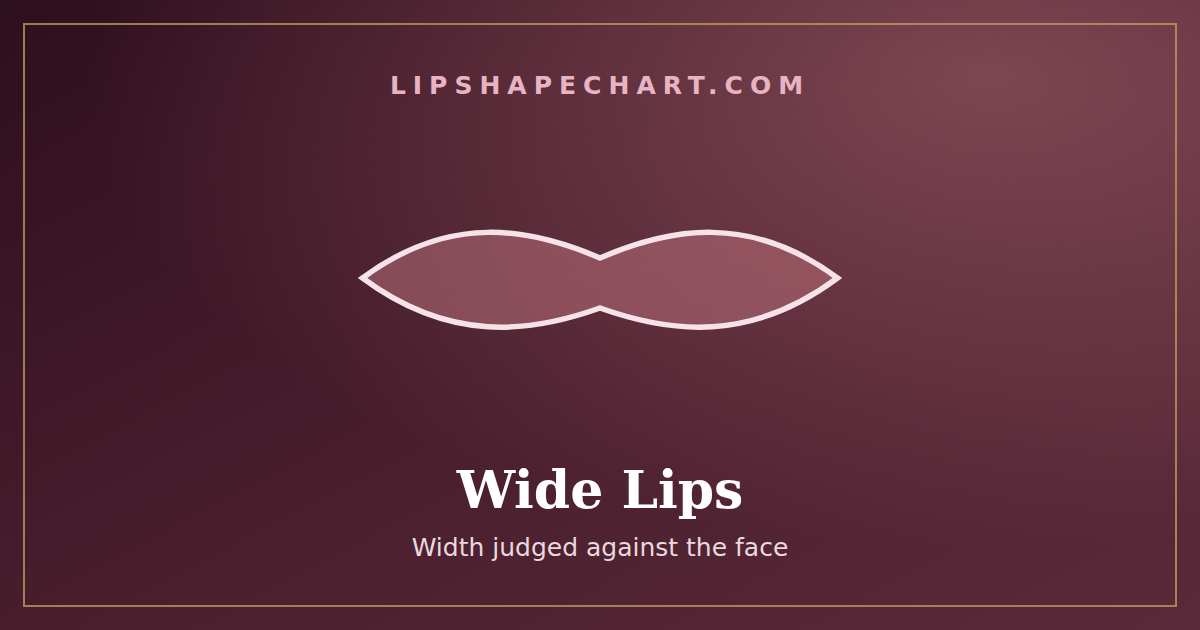
Wide lips are lips whose mouth width is large in proportion to the face, with the corners reaching past the base of the nose and past the inner eye line.
Width is judged against your own face, not against another person’s mouth. A mouth that looks wide on a narrow face may look ordinary on a broader face, even if both measure the same in millimetres. That is why a ratio gives a more honest answer than width alone.
Key takeaways
- Wide describes mouth width in proportion to the face, not lip height or fullness.
- The corners reach past the base of the nose and past the inner eye line.
- A width-to-face ratio above about 0.42 reads as wide, while 0.34 to 0.42 is typical.
- Wide and thin are different traits, and a wide mouth can be mistaken for thin lips.
- The detector gives one main shape label plus a secondary trait.
What wide lips are
Wide lips are defined by horizontal reach. The mouth extends further across the lower face than is typical for the width of that face, so the corners sit noticeably further out. Lip height plays no part in this label, which is why wide lips can be full, thin, or in between.
Think of the face as the frame and the mouth as a line inside it. On a wide mouth, that line takes up more of the frame from side to side, so the mouth becomes a strong feature. On a narrower mouth, the same lip height sits inside a shorter line and reads differently.
Width is only one part of a full result. The complete picture also covers fullness, the balance between the upper and lower lip, and details such as the Cupid’s bow and the corners. You can see how width sits alongside the other traits in the guide to the types of lips, which sets out all nine labels used on this site.
A wide label says nothing about whether the shape suits you, because there is no single ideal width. Faces vary a great deal, and a wide mouth is part of what gives a face its character. The label is a description to work from, not a grade.
How to identify wide lips
Start with proportion rather than size. A small face with a modest mouth can still be wide in proportion, while a larger face can carry a bigger mouth that sits inside the typical range. Each check below compares your mouth with landmarks on your own face.
Mirror checks
Rest your face and look straight into the mirror with your lips closed and relaxed. Drop an imaginary vertical line down from the base of each side of your nose, and note where your mouth corners fall. On a wide mouth, the corners reach past the base of the nose rather than ending inside those lines.
Next, use the inner eye line, imagining a vertical line dropping from the inner corner of each eye. If your corners reach past that line as well, on both sides, width is the likely explanation. Check at rest and not while smiling, because a smile pulls the corners outwards and makes almost any mouth look wider.
A straight photograph at arm’s length, with the camera level with your face, makes both checks easier. Comparing the two sides also helps, since most faces are slightly uneven and one corner may sit a fraction further out.
What the detector measures
The lip shape detector turns those mirror checks into a ratio. It divides mouth width by cheekbone width to give a width-to-face ratio, and a result above about 0.42 reads as wide. Results from 0.34 to 0.42 sit in the typical range, so a result just above 0.42 is only just wide.
The tool runs in your browser, uses 478 face landmarks, and takes ten measurements in six families, and nothing is uploaded. It returns one of nine shape labels plus a secondary trait, so width can appear as the main label or as a secondary trait. You can compare your result with the nine shapes on the lip shape chart.
If your ratio sits close to the borderline, treat it as a guide rather than a verdict. Head angle, camera distance, and a slight smile can all shift the landmarks a little. A second photograph, straight on and fully relaxed, is the simplest check.
Wide vs thin lips: the mix-up that causes most confusion
This pair catches more people out than any other on this site. Wide describes how far the mouth reaches across the face, while thin describes how much lip height there is for the width of the mouth. Because the two measurements use the mouth in different ways, the same mouth can honestly be both.
Here is why the mistake happens so often. Picture a mouth that stretches a long way across the face but has only average lip height, so each lip is of ordinary depth. Spread that average height along a longer line, and each lip looks like a narrower strip than it would on a shorter mouth, so the eye calls it thin.
The fullness ratio separates the two labels cleanly. It is total lip height divided by mouth width, so a longer mouth lowers the ratio even when lip height stays exactly the same. A result of 0.28 or below reads as thin, while 0.42 or above reads as full, and anything between those points sits in the middle range.
Two people can have the same lip height in millimetres, yet the person with the wider mouth will have the lower fullness ratio and the thinner-looking lips. Neither has less height, and the difference lies in the length the height is spread across.
To tell the labels apart, ask two separate questions in order. First, how wide is the mouth against the face, using the nose and inner eye checks or the width-to-face ratio. Second, how much height is there for that width, using the fullness ratio rather than a glance at one lip.
If the first answer is wide and the second sits in the middle range, your lips are wide, not thin, whatever the mirror first suggested. If both answers point the other way, wide and thin together is the accurate description, and the thin lips guide covers the height side of that pairing. Keeping the questions apart stops one glance from giving you the wrong label.
What else combines with wide lips
Few mouths carry one trait on its own, and width is no exception. The detector reports a primary label plus a secondary trait, so a result might name the main shape first and then add width, fullness, or corner direction as the extra detail. That pairing is usually more useful than a single word.
Wide and full is the pairing people most often picture with a wide mouth. The mouth reaches a long way across the face and carries plenty of height as well, giving a fullness ratio of 0.42 or above. If that sounds like you, the full lips guide covers the fullness side of the pairing.
Wide and thin is the opposite pairing, and it sits behind the confusion covered above. The reach is there, but the height is low for that width, with a fullness ratio of 0.28 or below. Wide with downturned corners is another common mix, where the corners sit lower than the centre of the mouth and give a more serious expression at rest.
Balance between the two lips can vary independently of width as well. The upper-to-lower ratio is most commonly between 0.6 and 0.9, while above about 1.0 reads as top-heavy and below about 0.6 reads as bottom-heavy. A wide mouth can fall into any of those groups, so read the full result rather than stopping at the first word.
Makeup and finish for wide lips
The aim with a wide mouth is usually balance, not disguise. Small choices about where colour starts and stops can change how wide the mouth reads. A few deliberate adjustments will do more than heavy application of any single product.
Define the upper border with a liner in a slightly deeper shade, and keep the lower lip lighter. That contrast gives the upper lip clear definition, while the softer lower lip stops the whole mouth from looking heavier and broader. Lipstick or gloss can then sit inside the liner, following the natural edge.
Where you stop matters as much as the shade you choose. Stop the liner just before the corners, and angle it very slightly upwards as you reach the outer edge. Leaving the corners unlined stops the colour stretching the full length of the mouth, so it does not read wider, and the slight upward angle lifts the finish.
Keep the rest of the application simple and precise. Colour placed mainly towards the centre, blended outwards without a hard edge at the corners, keeps the focus in the middle. A satin or soft matte finish usually suits this approach, since glossy colour out to the corners draws the eye along the full width.
FAQs
Are wide lips the same as big lips?
No, wide lips are not the same as big lips.
Wide describes reach across the face, while big is a loose word that mixes width, height, and fullness together. A mouth can be wide with only average height, and a shorter mouth can look big because it carries a lot of height.
Can lips be wide and thin at the same time?
Yes, lips can be wide and thin at the same time.
Width is judged against the face, while thinness comes from the fullness ratio of total lip height divided by mouth width. A long mouth lowers that ratio even when lip height is average, which is why the pairing is so common.
How wide is wide in measurements?
A width-to-face ratio above about 0.42 reads as wide.
That ratio is mouth width divided by cheekbone width, and the typical range runs from 0.34 to 0.42. A result just above 0.42 is only just wide, so borderline results are worth checking with a second straight-on photograph.
Do wide lips suit bold lipstick?
Yes, wide lips can carry bold lipstick very well.
A strong colour follows the full width of the mouth, so it makes a clear statement and suits many wide mouths. If you want a softer effect, keep the deeper liner on the upper lip, leave the lower lip lighter, and stop the colour before the corners.
Will the detector always call my lips wide if they look wide?
No, the detector may not call your lips wide even if they look wide to you.
The tool judges width as a ratio against cheekbone width, not by appearance alone, and it takes ten measurements in six families from 478 landmarks. A mouth that looks wide because it is thin may be labelled thin instead, and nothing is uploaded, since the tool runs in your browser.