
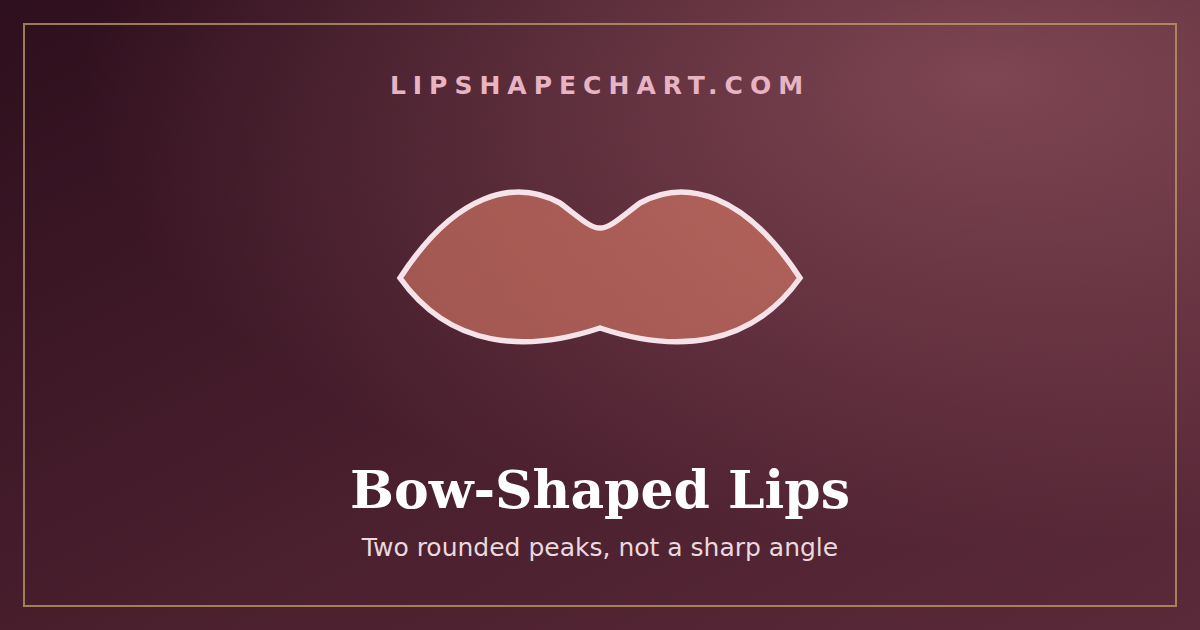
Most people check their Cupid’s bow in the mirror and see either a soft curve or a sharp point, yet many charts give that same outline two different names. That small detail at the centre of the upper lip is the whole reason bow-shaped lips are so often mislabelled. If your upper lip rises into two gentle, rounded peaks, you are probably looking at a bow shape, not a heart shape.
The confusion matters because the label changes the advice that follows it. Liner placement, gloss placement and even how full your lips appear can all shift once you know which outline you actually have. This guide explains the shape in plain terms, shows you how to check it yourself, and sets out the one rule that separates bow from heart.
Quick answer
Bow-shaped lips have two rounded peaks on the upper lip, with a soft dip between them and usually a flatter lower lip.
That rounded outline is the defining feature, and it stays visible whether your lips are full or thin. Size, colour and fullness can vary a great deal from person to person. The shape itself is decided by the curve of the upper lip alone.
Key takeaways
- Two rounded peaks on the upper lip, not one sharp central point
- A soft, shallow dip sits between the two peaks
- The lower lip is usually flatter than on heart-shaped lips
- Fullness is a separate trait that can combine with a bow shape
- A defined bow reads at a Cupid’s bow depth above about 0.10
What bow-shaped lips are
Bow-shaped lips take their name from the outline of the upper lip, which curves like the top of a tied bow. Two rounded peaks sit on either side of the centre, and a gentle dip joins them in the middle. Seen from the front, the upper lip looks symmetrical, soft and clearly defined without looking pointed.
The peaks are curves, not corners, and that is what gives the shape its character. Light tends to catch both peaks evenly, so the upper lip often looks balanced even before any product is applied. The lower lip, by contrast, usually follows a flatter and simpler line underneath.
A bow shape says nothing on its own about size. Bow-shaped lips can be full, thin or somewhere in between, and they can appear on a wide mouth or a narrow one. The wider guide to the nine main shapes at https://lipshapechart.com/types-of-lips/ places bow alongside the other labels so you can compare them side by side.
It also helps to separate shape from proportion. The fullness ratio, worked out as total lip height divided by mouth width, describes how full lips look overall, with 0.28 or below reading as thin and 0.42 or above reading as full. That measurement can support the main label, but it never replaces the rounded peaks as the deciding sign.
How to identify bow-shaped lips
Start with a relaxed face in good, even light, with your mouth closed naturally and no product on your lips. Look straight into the mirror and focus only on the top edge of your upper lip. Ask yourself whether that edge forms two separate rounded humps, or whether it meets in a single pointed peak at the centre.
Next, check the dip between the peaks. On bow-shaped lips the dip is soft and shallow, more like a gentle valley than a sharp notch. Trace the outline slowly from one corner to the other, and you should feel two smooth rises rather than one sudden angle in the middle.
Then look at your lower lip for supporting evidence. A flatter lower lip, without a strong fullness at its centre, fits the bow pattern well. It is only supporting evidence, though, because the upper lip outline remains the main test in every case.
If you want a measured reading instead of a mirror judgement, the tool at https://lipshapechart.com/lip-shape-detector/ runs in the browser and uses 478 face landmarks to map your lips. It takes ten measurements in six families, nothing is uploaded, and it returns one of 9 shape labels plus a secondary trait. A Cupid’s bow depth above about 0.10 of total lip height reads as a defined bow, and on a bow shape the peaks register as curves rather than as an angle.
That detector reading is useful when the mirror leaves you unsure. A borderline dip can look different under harsh bathroom light and in softer daylight, while a measurement gives you the same answer each time. You can also compare your result with the visual reference at https://lipshapechart.com/lip-shape-chart/ to see how your outline sits among all nine shapes.
Bow-shaped lips vs heart-shaped lips: the key difference
This is the pair that causes more confusion than any other on a lip shape chart, because both shapes have a noticeable Cupid’s bow. The difference lies in how the centre of the upper lip is formed. Bow-shaped lips have two rounded peaks, while heart-shaped lips have a sharp angle at the centre of the upper lip.
Picture the two outlines side by side and the contrast becomes clear. A bow looks like two soft hills with a shallow valley between them, smooth all the way across. A heart looks more like a point or a V at the centre, where the two sides meet at a definite angle rather than curving apart again.
The lower lip usually reinforces the difference. Bow-shaped lips tend to pair with a flatter lower lip, which keeps the attention on the rounded upper outline. Heart-shaped lips more often pair with a fuller centre to the lower lip, which mirrors the pointed upper lip and makes the whole mouth look more heart-like. Our companion guide at https://lipshapechart.com/heart-shaped-lips/ covers that shape in full, including how its central angle is measured.
There is also a short taxonomy note worth knowing before you compare charts. Charts disagree on heart vs bow, and some swap the names or blur them into one category altogether. This site’s rule is plain: heart-shaped means a sharp angle at the centre of the upper lip, and bow-shaped means two rounded peaks. If you read a different label elsewhere, that chart may simply be using the opposite naming, so check its definition rather than assuming your lips have changed.
A simple test settles most cases in seconds. If the centre of your upper lip would prick a fingertip, metaphorically speaking, you are closer to heart, and if it rolls smoothly over two curves, you are closer to bow. When the outline is genuinely mixed, trust the centre first, because that single point is where the two definitions part company.
What else combines with bow-shaped lips
A shape label is rarely the whole story, because lips carry several traits at once. The detector therefore reports a primary label plus a secondary trait, so a result might read as bow-shaped with a fuller or top-heavy tendency. That second trait explains why two people with the same main label can still look quite different.
Bow with full is one common combination. It keeps the two rounded peaks, but the overall fullness ratio reaches 0.42 or above, and the guide at https://lipshapechart.com/full-lips/ explains that fuller pattern in detail. The peaks often look softer on fuller lips, simply because there is more surface for light to spread across.
Bow with top-heavy is another pairing to watch for. It appears when the upper-to-lower ratio rises above about 1.0, while the most common range sits between 0.6 and 0.9. Below about 0.6 the balance reads as bottom-heavy instead, which gives a useful contrast when you judge your own proportions.
Bow with a flatter lower lip is the classic version described earlier in this guide. The upper lip does most of the visual work, and the lower lip stays comparatively straight and calm. None of these combinations changes the main label, as long as the two rounded peaks remain the clearest feature of the upper lip.
Makeup and finish for bow-shaped lips
The aim with bow-shaped lips is to honour the curve you already have, rather than redraw it into something straighter. Use liner to define each peak precisely, following the natural rounded rise and fall of your own outline. Work slowly around one peak at a time, keep the line close to the edge, and resist the urge to flatten the dip into a straight line.
Lipstick choice can stay simple once the outline is right. Satin and soft matte finishes tend to show the twin peaks clearly, while very glossy finishes can blur them under strong light. A shade close to your natural lip colour gives the most faithful reading of the shape, and a stronger colour makes the bow outline stand out further.
For balance, add a touch of gloss at the centre of the lower lip. That small highlight balances the defined upper lip without making the lower lip look artificially fuller. Keep the gloss confined to the centre, blend its edges lightly, and the flatter lower lip will catch just enough light to complete the picture.
FAQs about bow-shaped lips
Are bow-shaped lips the same as heart-shaped lips?
No, bow-shaped lips have two rounded peaks, while heart-shaped lips have a sharp angle at the centre of the upper lip. The two shapes are close cousins, which is why they are confused so often. Check the centre of your upper lip first, because that point decides the label on this site. The lower lip then offers support, flatter for bow and fuller at the centre for heart.
Why does another chart call my lips heart-shaped?
Another chart may call the same lips heart-shaped because charts disagree on the naming for this pair. Some swap the two names, and others merge them into a single category. This site keeps a plain rule, with heart meaning a sharp central angle and bow meaning two rounded peaks. Compare definitions before you compare labels, and the disagreement usually disappears.
Can bow-shaped lips also be full or thin?
Yes, bow-shaped lips can be full, thin or in between, because fullness is a separate trait from shape. The fullness ratio compares total lip height with mouth width, reading thin at 0.28 or below and full at 0.42 or above. Your peaks decide the bow label on their own. Fullness simply arrives as a secondary trait alongside it.
How does the detector decide on a bow shape?
The detector reads the curve of your upper lip and measures how deep your Cupid’s bow sits. A depth above about 0.10 of total lip height reads as a defined bow, and the peaks must register as curves rather than an angle. The tool runs in your browser, uploads nothing, and returns a primary label plus a secondary trait. That combination makes borderline cases easier to settle than a mirror check alone.
What lipstick finish suits bow-shaped lips best?
A satin or soft matte finish usually suits bow-shaped lips best because it keeps both peaks clearly visible. Very glossy finishes can blur the outline under bright light, although a small amount of gloss still works well. Place that gloss only at the centre of the lower lip for balance. Keep liner precise around each peak, and the natural bow shape will do the rest.