
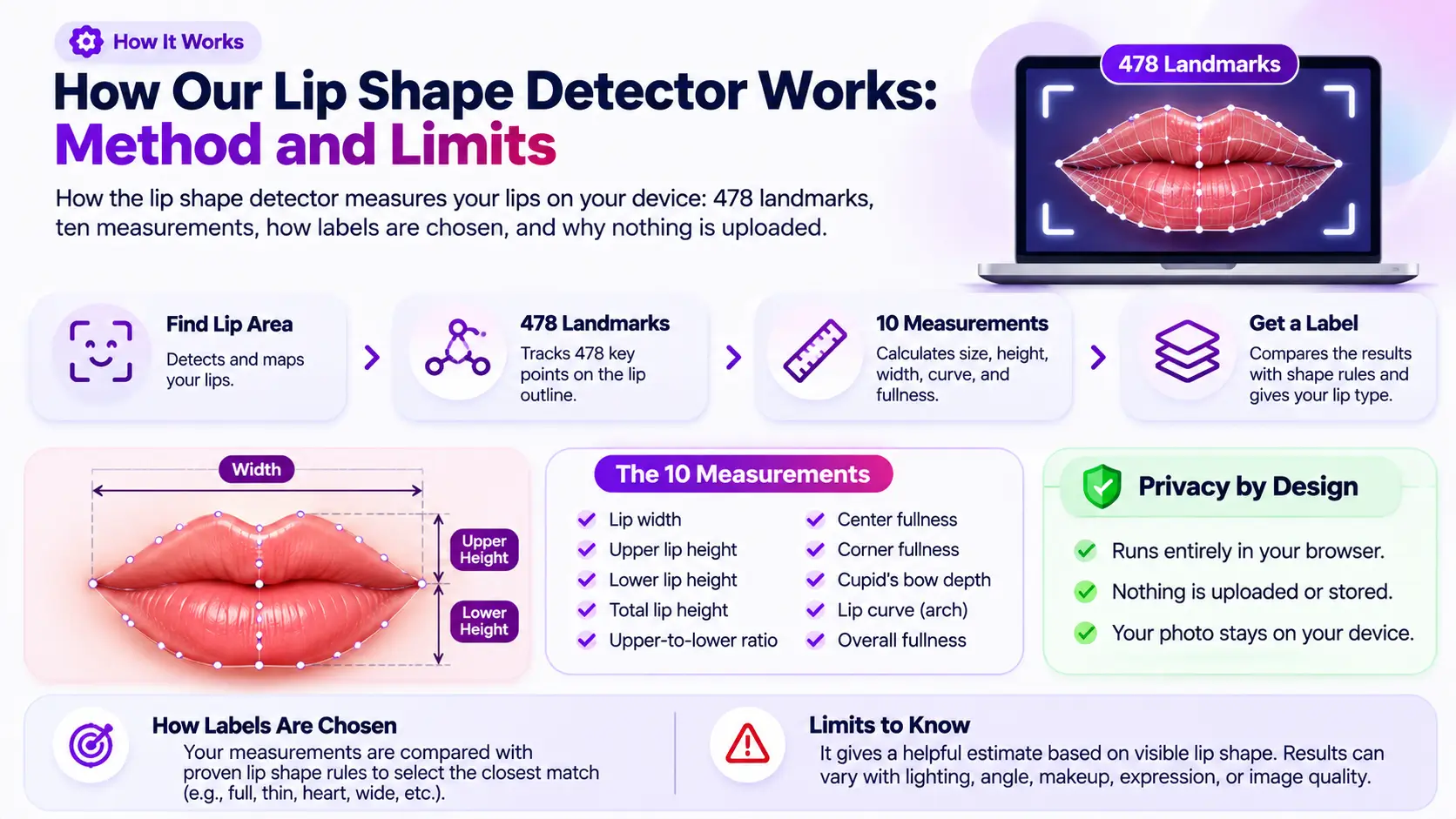
The detector finds the outline of your lips in a photo, measures ten values from that outline, and matches those ratios to the closest of the 9 lip shapes. It runs entirely in your browser. Nothing is uploaded.
This page is the full method: what is measured, what the numbers mean, how the label is chosen, and what makes the answer wrong. If you only want the result, go straight to the lip shape detector. If you want to check the reasoning first, stay here.
How it works in 3 steps
Step 1: The face is mapped with 478 landmark points
The tool uses Google MediaPipe Face Landmarker, a face-mesh model that runs in the browser and places 478 points on a face in a photo or camera frame. Around 40 of those points sit on and around the mouth. They trace the outer and inner lip lines, the two corners, and the two peaks and central dip of the Cupid’s bow.
The formal landmark names behind the key points come from craniofacial research: cheilion for the mouth corners, labiale superius for the top of the upper lip at the midline, stomion for the point where the lips meet, and labiale inferius for the bottom of the lower lip. The detector does not need you to know these names. They are listed here so the method can be checked against the research it rests on.
Source: Google MediaPipe Face Landmarker documentation and the peer-reviewed study of automated craniofacial landmark detection indexed by the National Center for Biotechnology Information (NCBI).
Step 2: The outline is levelled, then measured
A tilted head skews every ratio, so the tool first levels the outline using your eye line. This roll correction means a photo taken at a slight angle is measured as if the head were straight.
It then calculates ten measurements from the levelled outline. Every measurement is a ratio, not an absolute size, and each one is normalised against a face reference such as cheekbone width. That is why the result does not depend on how close the camera was, and why the same method works on any face size.
Step 3: The ratios are matched to a lip shape
Each ratio is scored against the thresholds in the table below. The shape whose profile your ratios sit closest to becomes your primary shape. The runner-up becomes your secondary trait, because most people are a combination of two shapes. The result screen shows the label and every number behind it, so you can see which measurement drove the answer. How the label is chosen is explained in full under How the primary and secondary label is chosen.
What it measures: ten measurements in six families
This table is the canonical list for the whole site. It shows the six families the measurements fall into. On the result screen they appear as ten values: mouth width against face width, lip height against face width, combined lip height, the upper-to-lower ratio by height and by area, the Cupid’s bow depth index, the Cupid’s bow angle, corner height, the left-to-right difference, and lip area against the face. The same thresholds are the ones summarised on the homepage and on the detector page.
| Measurement | How it is calculated | Typical range and what it decides |
|---|---|---|
| Width-to-face ratio | Mouth width divided by cheekbone width | 0.34 to 0.42 is typical. Above that range reads as wide |
| Fullness | Total lip height divided by mouth width | Below ~0.28 reads as thin. Above ~0.42 reads as full |
| Upper-to-lower ratio | Upper lip height divided by lower lip height at the centre | 0.6 to 0.9 is most common. Above ~1.0 reads as top-heavy. Below ~0.6 reads as bottom-heavy |
| Cupid’s bow depth | Peak-to-dip height divided by total lip height | Above ~0.10 reads as a defined bow, which separates heart-shaped and bow-shaped from the softer shapes |
| Corner tilt | Corner height compared with the mouth centre line | Level, up or down. Corners below the centre line at rest add the downturned trait |
| Symmetry | Left side compared with right side for width and corner height | 90 percent or above is normal. Perfect symmetry is rare and is not expected |
Three points about these numbers matter.
First, they are thresholds for labelling, not population statistics. Fullness above 0.42 is where this tool starts calling lips full. That is a stated convention you can check, not a claim about how many people in the world have full lips.
Second, the upper-to-lower ratio needs context. Many aesthetic guides cite roughly 1 to 1.6 as a classic proportion. The range this detector treats as most common, 0.6 to 0.9, is consistent with that: a lower lip moderately taller than the upper is the usual human pattern, which is why bottom-heavy is a common result and not a flaw.
Third, no single measurement decides your shape. Fullness says nothing about the bow, and corner tilt says nothing about width. The label comes from the pattern across all ten, which is why two people with the same fullness can correctly get different shapes.
How the primary and secondary label is chosen
Your highest-scoring shape becomes the primary label, and the closest runner-up becomes the secondary trait.
Each measurement votes, in effect, for the shapes its value supports. A fullness reading above 0.42 supports full. A bow depth above 0.10 supports heart-shaped or bow-shaped, and the shape of the peaks and the lower lip then separates those two: a sharp angle with a centre-full lower lip points to heart-shaped, two rounded peaks with a flatter lower lip point to bow-shaped. Corner tilt can add downturned to any result, because corner direction is independent of volume.
When no single trait stands out, the honest answer is a balanced result with a secondary trait close behind, not a forced label. When your top two shapes score closely, the result says so. Treat a close result as a combination, because that is what it is. A result such as wide and thin is not the tool contradicting itself: width and fullness are separate measurements, and a mouth can be both.
If two photos give you two different primary labels, read the numbers before you distrust the tool. In most cases one ratio has moved across a threshold because your expression changed, and the secondary trait on each result is the other photo’s primary. The fuller explanation of mismatches is in What Is My Lip Shape?
What breaks it
These are the known failure modes. The detector checks for several of them before answering and will refuse a photo it cannot read rather than guess.
- Head tilt and camera angle. Roll correction fixes a slight tilt. It cannot fix a photo shot from well above or below, which exaggerates one lip at the expense of the other.
- Smiling, pouting or an open mouth. A smile widens the mouth and flattens the Cupid’s bow. A pout inflates fullness. Both move ratios across thresholds.
- Uneven or harsh lighting. Side light can blur one corner in shadow and lower the symmetry reading or fake a downturned corner.
- Beauty filters. Filters reshape lips by design. A filtered photo measures the filter, not your lips.
- Heavy lip liner, overlining and dark lipstick. The tool traces the visible border. Makeup that redraws the border moves the outline it measures.
- Very recent filler or swelling. Temporary volume changes the ratios. Wait until swelling has settled before treating a result as your baseline.
Best input is simple: front-facing, camera at eye level, even light, relaxed closed mouth, bare lips or light nude colour, no filter.
How accurate is it? An honest answer
The landmark model is consistent. The label is an interpretation. Those are two different claims, and only the first one is strong.
Given the same photo, the model finds the same outline and produces the same ratios. That repeatability is real, and it is why a measured result beats a guess in a mirror. But turning ten measurements into one of 9 names involves thresholds, and thresholds involve judgement. Lip shape itself is continuous: real lips vary smoothly, and the 9 categories are descriptive labels placed on that variation, mostly from makeup and aesthetic practice. There is no official medical list of lip shapes for a detector to be accurate against.
So no accuracy percentage is claimed here, and any tool that promises one for lip shape classification should be asked what it was measured against. The practical test is consistency: take two or three neutral photos. If the primary shape is the same each time, rely on it. If it flips between two labels, you sit between them, and the pair of labels together is your accurate answer.
The detector is a styling and identification aid. It is not a medical assessment, it says nothing about your health, and it cannot tell you whether a cosmetic procedure suits you. Its full limits are also stated on the detector page and in the site disclaimer.
Your photo never leaves your device: the privacy architecture
All processing happens on your device, inside your browser. There is no upload step to trust, because there is no upload step at all.
The face landmark model file, about 4 MB, downloads to your browser the first time you use the tool, in the same way an image or a font downloads. Your photo travels in no direction: it is drawn onto a local canvas, analysed there, and discarded when you close the tab. No image is sent to a server, no facial data is stored, and there is no account. Camera mode works the same way, reading frames locally and using the median of five readings to remove frame-to-frame jitter.
If you use the download result card button, the card is generated on your device. Saving or sharing it is your action, not the site’s. The full data position is set out in the privacy policy, and the short version is the whole version: the site cannot store your photo because your photo never reaches the site.
If you do not want to use a photo
Use the mirror route instead. The lip shape quiz asks you to observe the same traits the detector measures: where the fullness sits, how sharp the bow is, how width compares with height, and where the corners rest. It is less precise than a measurement because it depends on your observation, and it needs no camera at all.
A sensible order is quiz first to learn what you are looking at, detector second to measure it. Where the two agree, you have your answer. Where they disagree, you are near a boundary between two shapes, which is the normal case.
How our lip shape detector works: FAQs
How does the lip shape detector work?
It maps 478 face landmark points in your photo, traces the lip outline, and calculates ten measurements from that outline.
The ratios cover width, fullness, upper-to-lower balance, Cupid’s bow depth, corner tilt and symmetry. The shape whose profile your ratios match most closely becomes your result, with the runner-up shown as a secondary trait.
Is my photo uploaded or stored when I use the detector?
No. Your photo is never uploaded or stored.
The model downloads to your browser, about 4 MB, and the analysis runs on your device. Your image is discarded when you close the tab. There is no server copy because the image never reaches a server.
How accurate is the lip shape detector?
The measurements are repeatable, and the label is an estimate. No accuracy percentage is claimed.
The landmark model produces the same ratios from the same photo. The step from ratios to a shape name uses stated thresholds on a topic, lip shape, that has no official classification to be measured against. Take two or three neutral photos: a stable primary shape across them is the result to rely on.
What are the measurements the detector uses?
Width-to-face ratio, fullness, upper-to-lower ratio, Cupid’s bow depth, corner tilt and symmetry.
Each one is defined with its typical range in the measurement table on this page. The result screen on the lip shape detector shows your own values next to your label.
Why did I get two lip shapes instead of one?
Because most lips are a combination of two shapes. The detector returns a primary shape plus a secondary trait for that reason.
The 9 shapes describe independent traits. Width says nothing about fullness, so a result like wide and thin is a fuller description, not an error.
Does the detector work for men?
Yes. The detector measures proportions, and the same measurements are used for every face.
Lip shape names describe outline and balance, not gender. Average proportions differ between men and women, but the measurement method and the thresholds are applied in the same way.
Can I use the detector with lipstick on?
Yes, but light or nude shades give the cleanest result. Dark lipstick and overlining can shift the result.
The tool traces the visible border of the lip. Makeup that redraws that border outward will be measured as if it were lip, which inflates the fullness reading.