
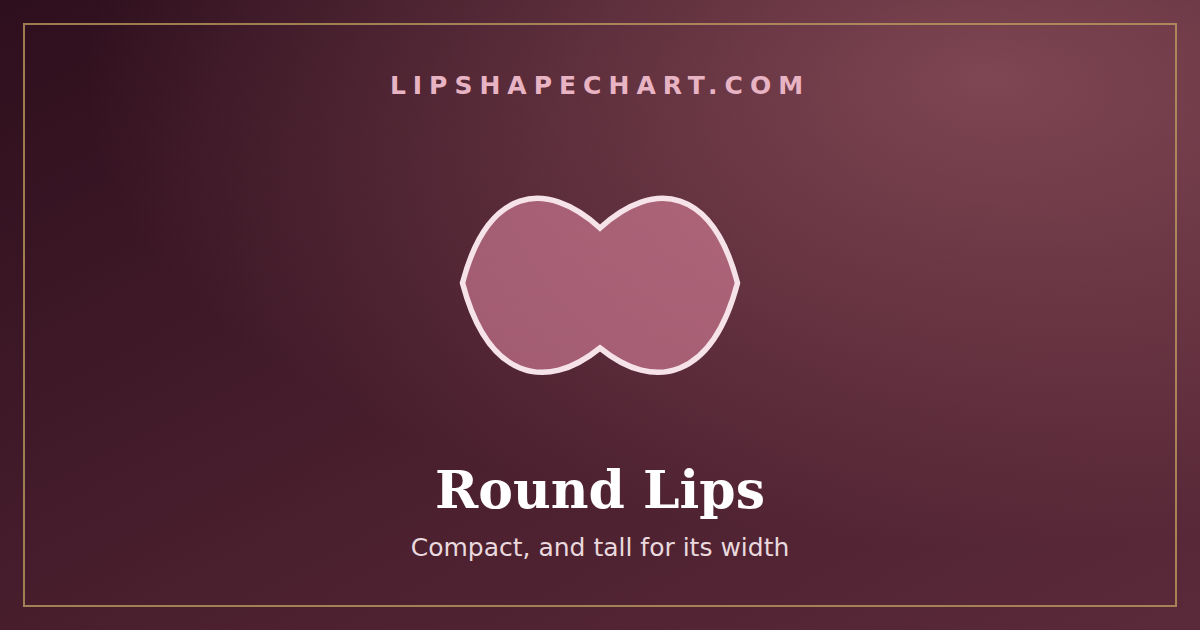
Round lips are the shape people most often spot in a photograph of someone else, then fail to see in their own mirror. In a photo the mouth looks like a neat, self-contained oval, yet up close the same mouth can look simply full, or even quite ordinary.
That mismatch happens because round is about the outline, not about how much lip you have. Once you stop judging size and start judging the shape of the border, the label becomes much easier to test.
Quick answer
Round lips are compact lips that are tall for their width, with a softly curved outline and no sharp angle anywhere.
Height sits close to width here, so the mouth reads as gathered rather than spread out. The corners stay tucked in, the Cupid’s bow is usually softened, and the whole shape fits inside a small, tidy area of the face.
Key takeaways
- Round describes a compact outline, not a large or small mouth.
- Height is close to width, which is why the mouth looks tall for its size.
- There is no sharp angle anywhere on the outline, including at the corners.
- Full lips carry volume out toward the corners, while round lips stay compact.
- The fullness ratio alone does not decide round, because round lips can sit in the middle fullness range.
- Makeup works best on the natural border, with a crisp outline and no overlining.
What round lips are
Round lips have height that comes close to their width, which gives the mouth a tall, gathered look. Most mouths are far wider than they are tall, so this near balance between the two measurements stands out. The outline curves continuously from corner to corner, without flattening into a long horizontal line.
The outline is also compact, meaning the shape does not stretch far across the face. The corners stay in rather than pulling wide, and the lips occupy a contained space below the nose. You can often draw a rough circle or short oval around the whole mouth and lose very little of the shape outside it.
No sharp angle appears anywhere on that outline, and this is the detail people miss. The Cupid’s bow may still be present, but its peaks are softened into curves rather than points. The corners likewise turn gently instead of forming a crisp angle, and the lower lip rounds under in one smooth arc.
Fullness here is about proportion, not size, so a round mouth does not have to be big. A small mouth can be round if it is tall for its width and keeps that curved, compact outline. A larger mouth can fail the test completely if its width runs well ahead of its height, however much volume it carries. The wider guide to all nine shapes on the types of lips page shows how round sits alongside the other labels.
How to identify them
Start with a relaxed mouth in a mirror, in plain daylight, with no smile and no pressure between the lips. Smiling pulls the corners wide and flattens the outline, which can turn a round mouth into a wide one for as long as the smile lasts.
First, compare height against width, using the combined height of both lips at the centre. If that height looks surprisingly close to the width of the mouth, round is a serious candidate. If the width is clearly two or three times the height, the mouth is more likely to belong to another shape family.
Second, check whether the corners stay in, rather than reaching out across the face. Round corners sit close to the centre of the mouth and turn softly, so the whole shape stays contained. You can test this against the width-to-face ratio, which is mouth width divided by cheekbone width: 0.34 to 0.42 is typical, and above that range a mouth reads as wide.
Third, run your eye slowly around the whole outline and look for any sharp angle. Check the Cupid’s bow peaks, the corners, and the point where the upper lip meets the lower lip at each side. If every turn is a curve and no point catches your eye, that absence of angles supports the round label.
The lip shape detector reads the same clues from a photo, looking for a compact outline with height close to width. It runs in the browser using 478 face landmarks, takes ten measurements in six families, and nothing is uploaded. The fullness ratio alone does not decide round, because that ratio, total lip height divided by mouth width, can sit in the middle range for round lips: 0.28 or below reads thin and 0.42 or above reads full, yet a mouth between those values can still be round in outline. The printable lip shape chart is a useful side-by-side check if you want to compare your outline against all nine shapes at once.
Round vs full: where the fullness sits
Round and full are confused more than any other pair, because both can show plenty of lip height at the centre. A round mouth photographed straight on can look plump, and a full mouth with soft corners can look gathered. The mistake is to decide the label from total volume, when volume is the one thing the two shapes can share.
Full lips carry their volume out toward the corners, so the height you see in the centre continues across the mouth. The lips still show real presence two thirds of the way across, and the shape spreads rather than gathers. Our guide to full lips sets out that pattern in detail, including how the fullness ratio of 0.42 or above supports it.
Round lips keep their fullness in the middle and stay compact, so the height drops away as you move toward the corners. The corners themselves stay in, the width stays short, and the outline keeps curving instead of extending. A round mouth can therefore have less total volume than a full mouth and still look fuller at its centre, simply because everything is concentrated in a smaller space.
The deciding check is where the fullness sits and how far the outline reaches, not how much volume there is in total. Follow the upper lip from the centre to one corner and ask whether the height holds up or fades away, then ask whether the corner reaches out or stays tucked in. Height that holds and corners that reach point to full, while height that fades and corners that stay in point to round.
Numbers help, but only as a supporting check rather than the verdict. A fullness ratio at or above 0.42 points toward full, yet a compact mouth with height close to its width can still be labelled round if the outline never spreads. That is why the detector weighs the outline and the width together, instead of letting one ratio overrule the shape it can trace.
What else combines with round lips
Round is a primary label, and most round mouths also carry a secondary trait that refines the result. The detector returns one of 9 shape labels plus a secondary trait, so a result such as round with a soft bow tells you more than the word round alone. That second trait often explains the feature you noticed first in the mirror.
Round with a soft bow means the Cupid’s bow is visible but its peaks are rounded rather than pointed. The bow adds a gentle dip at the top centre without breaking the rule of no sharp angle anywhere. If the peaks were crisp and defined, bow-shaped would be more likely to become the primary label instead.
Round and full is a common pairing, where the compact outline also scores high for fullness. The mouth stays short in width, yet both lips carry strong height, so it looks plump without looking wide. Round and bottom-heavy is another pairing, where the lower lip carries more of the height and the upper-to-lower ratio falls below about 0.6, the point at which a mouth reads as bottom-heavy.
Balance is judged with the upper-to-lower ratio, where 0.6 to 0.9 is most common and above about 1.0 reads as top-heavy. A round mouth can sit anywhere in that range, because balance and outline are separate traits. At the other end of the scale, a mouth that fails the round test on height may be closer to thin lips, where the fullness ratio falls to 0.28 or below.
Makeup and finish for round lips
Line on the natural border, following the outline that is already there rather than drawing a new one outside it. Round lips give you a clear, continuous edge to follow, so liner works best as a definition tool rather than a reshaping tool. Keeping to the border also preserves the proportions that make the shape recognisable in the first place.
Avoid overlining, which turns round into undefined, because the added colour sits on skin and blurs the border instead of enlarging the lip. The mouth does not read as bigger, it reads as softer at the edges, and the compact shape is lost. If you want more presence, build it with colour and finish inside the outline rather than with extra millimetres outside it.
Keep the outline crisp so the compact shape stays readable, especially at the corners and the Cupid’s bow. A clean edge, a satin or softly glossy finish, and colour placed evenly across both lips will keep the tall, gathered shape clear.
FAQs
Are round lips the same as full lips?
No, round and full are different labels, and a mouth can be one without the other. Full describes how much height the lips carry for their width, and that volume reaches out toward the corners. Round describes a compact outline that stays gathered, whatever the total volume happens to be.
Can round lips be small?
Yes, round lips can be small, because the label is about proportion rather than size. A small mouth that is tall for its width, with a curved outline and no sharp angle, still counts as round. Size only matters through the relationship between height and width.
How do I know if my Cupid’s bow is too sharp for round lips?
A softened bow fits round lips, while crisp, pointed peaks point toward a different primary label. Look at the two peaks at the top centre of the upper lip in a relaxed photo. If they read as gentle curves, they support round, and if they form clear points, bow-shaped is worth checking.
Can the detector get round lips wrong?
Yes, any single photo can mislead it, especially if you are smiling or the light flattens your outline. Smiling stretches the corners and changes both the width and the height it measures. Retake the photo straight on, with a relaxed mouth and even light, and compare the result with the mirror checks above.
What lipstick finish suits round lips best?
A satin or softly glossy finish usually suits round lips best, because it keeps the surface lively without blurring the edge. Apply colour inside a crisp, natural border so the compact outline stays clear. Very blurred or faded edges make the shape harder to read, so save those techniques for days when you want a softer effect.