
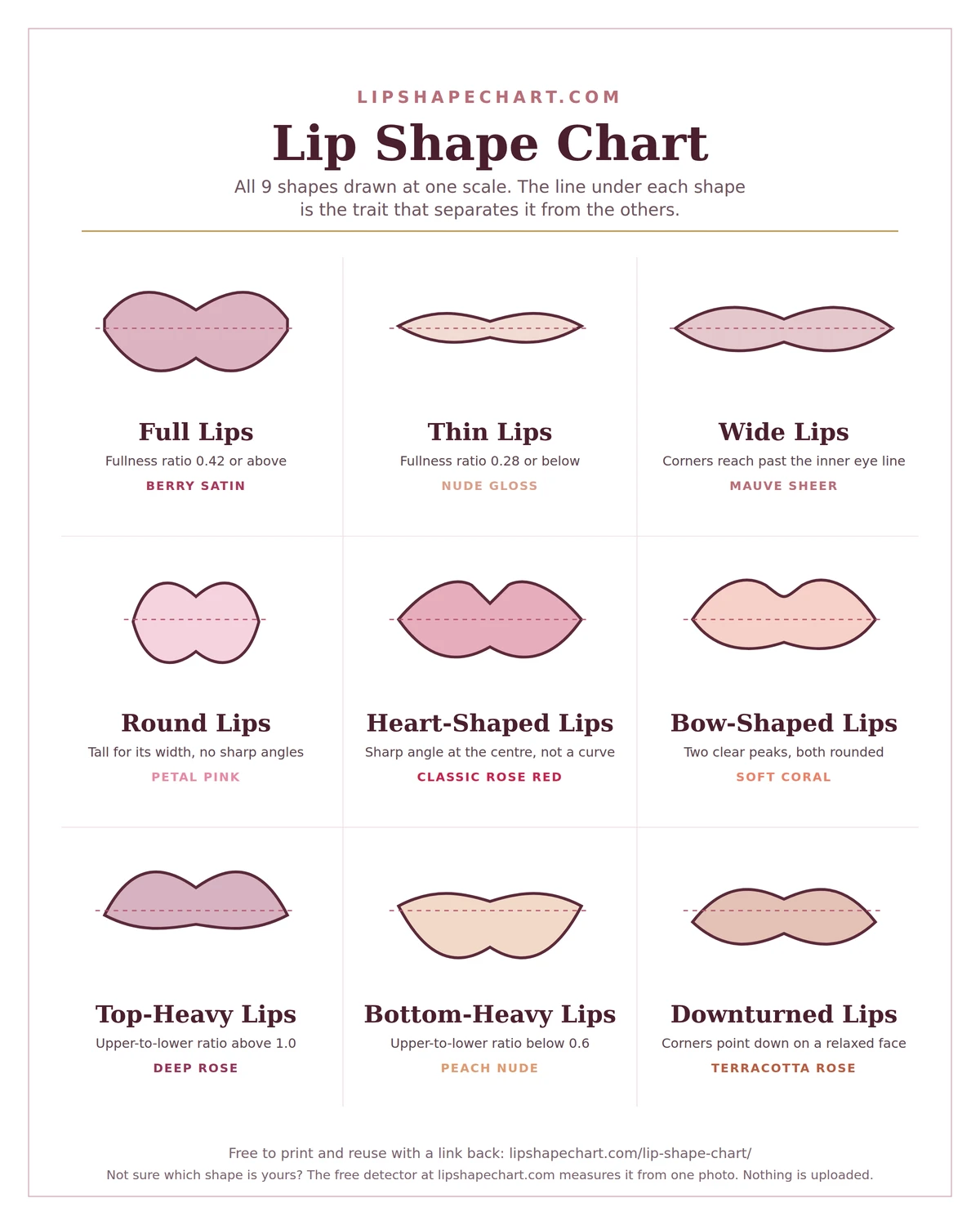
This chart is free to download, save and print. No sign-up, no email, no payment.
It puts the 9 common lip shapes side by side at the same scale, with the one trait that defines each shape written under it. Print it, hold it next to a mirror, and compare your own lips against it. If you would rather have the proportions measured for you, use the free lip shape detector instead.
This page is the printable version of the chart on our homepage. The full written guide to every shape is in Types of Lips.
The chart
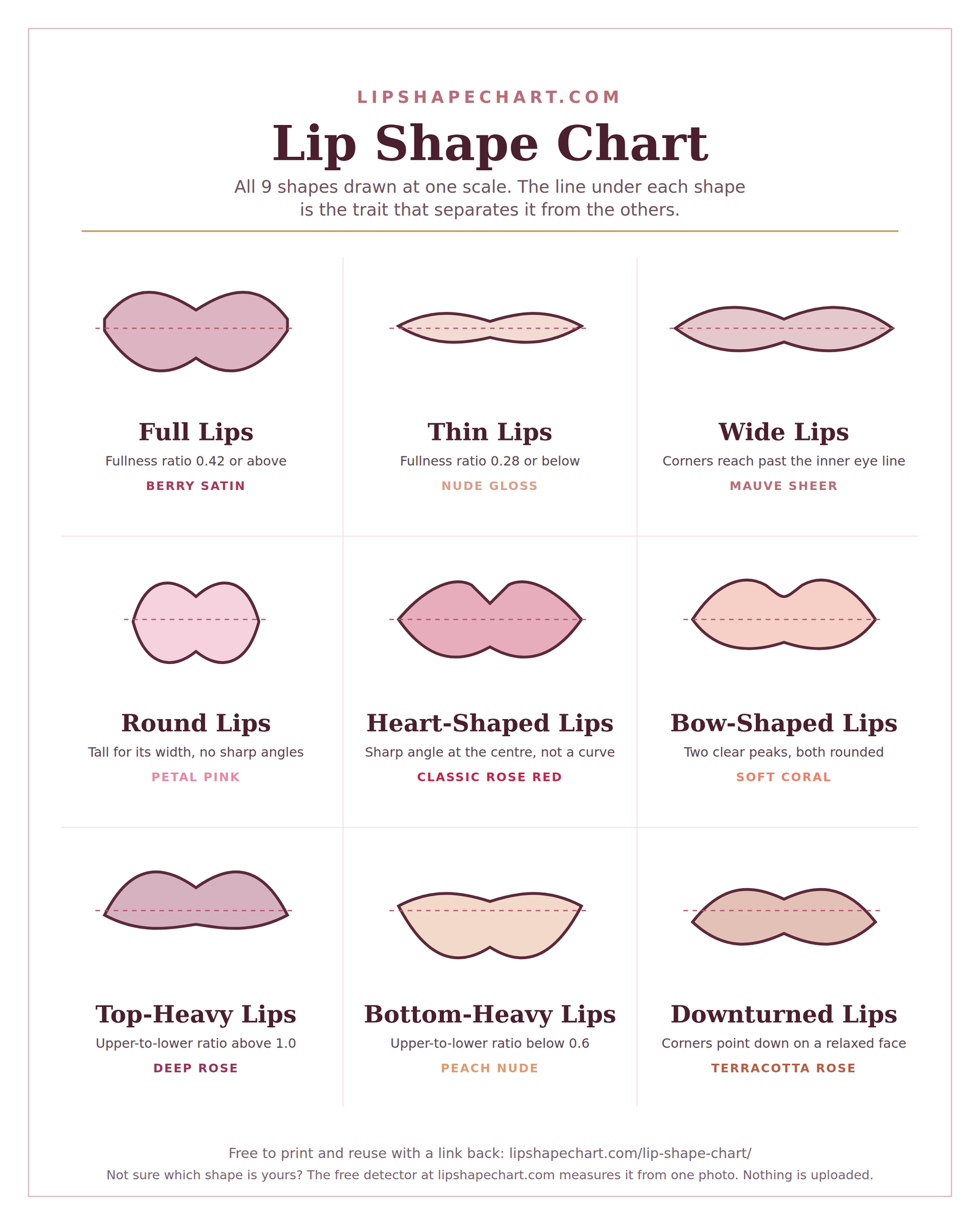
Every shape on the chart is drawn at one mouth width. That is deliberate. Lip shape is about proportion, not size, so holding the width constant is what makes the differences honest: a wide mouth with average height reads as thin, and a narrow mouth with the same height reads as full. Change the width between drawings and you would be comparing sizes, not shapes.
Each cell is labelled with the shape name and its defining trait. The chart is greyscale-safe, so a black and white home printout keeps all 9 shapes distinct, and it is laid out with print margins for both A4 and Letter paper.
The 9 shapes describe four independent traits: volume, upper-to-lower balance, width against height, and the contour of the Cupid’s bow and corners. Because the traits are independent, most people match two shapes, not one. The chart is a comparison tool for makeup and general interest. It is not a medical or standardised anatomical classification.
Download the chart
Two formats are provided, and both are free.
PDF for printing
The PDF is the version to print. It is laid out for A4 and Letter paper with safe margins, the chart on the first page and the comparison table from this page on the second page, so a printed copy is usable on its own without this website open. Print at 100 percent scale, not fit to page, so the shapes stay at one width.
PNG image for saving and sharing
The PNG is the version to save to a phone, add to slides or a worksheet, or share. It is a single high-resolution image of the 9-shape grid with the labels included, so the shape names travel with the picture when it is copied.
Both files are the same chart. Choose the PDF if you are printing, the PNG if you are saving or sharing on a screen.
How to use the chart in a mirror
Five checks, in order. The first two decide your main shape, the rest decide the second trait most people have.
1. Relax your mouth
Daylight, mirror at eye level, no lipstick, no smile, no pursing. A smile stretches the corners and flattens the Cupid’s bow, which hides the exact features you are checking. This is the step most people skip, and it is why most self-checks come out wrong.
2. Compare upper and lower volume
Look at the red of each lip, not the skin above it. Including that skin is the most common measuring error, and it makes almost everyone read as top-heavy. Clearly taller upper lip means top-heavy. Clearly taller lower lip means bottom-heavy. Similar height means continue to the next check.
3. Check the Cupid’s bow
A sharp point at the centre means heart-shaped. Two rounded, clearly readable peaks mean bow-shaped. A soft or almost flat dip points to full, round or thin instead.
4. Compare width against height
Much wider than tall means wide. Nearly as tall as it is wide means round. Judge it against the base of your own nose, not against other people’s mouths.
5. Look at the corners at rest
Do the corners sit below the centre line of your mouth, level with it, or above it? Below means downturned, as a trait added to whatever shape the earlier checks gave you. Check twice, because a small head tilt flips this answer.
Still unsure after the mirror check? Take the lip shape quiz for a scored answer from the same checks, read What Is My Lip Shape? for the full mirror method with photo tips, or let the detector measure the ratios from a photo.
The 9 shapes in one table
| Lip shape | Defining trait | Quick identifier |
|---|---|---|
| Full | Volume in both lips | Fullness reaches the corners |
| Thin | Low vertical height | Narrow red lip, relaxed mouth |
| Wide | Horizontal reach | Corners past the base of the nose |
| Round | Height close to width | Compact, circular outline |
| Heart-shaped | Sharp V plus full centre | A visible angle, not a curve |
| Bow-shaped | Rounded double peaks | Two clear peaks, flatter lower lip |
| Top-heavy | Upper taller than lower | Upper red taller than lower |
| Bottom-heavy | Lower taller than upper | Lower red clearly taller |
| Downturned | Corner direction | Corners below the centre at rest |
Two pairs cause most of the confusion. Heart-shaped against bow-shaped is angle against curve: a sharp point is heart, two soft rounded peaks are bow. Full against round is width: full carries its volume out toward the corners, round stays compact. The full explanation of every shape, with anatomy and makeup notes, is in Types of Lips.
Reuse and attribution
Yes, you can reuse this chart for free, with a link back.
You may copy, print and share the chart image and the PDF, including in classrooms, training material, blog posts and clinic waiting areas, as long as you credit Lip Shape Chart and link back to this page: https://lipshapechart.com/lip-shape-chart/
Three conditions apply. Credit must stay visible next to the chart, not buried in a footer or removed from the image. You may not sell the chart on its own or upload it to a stock or print-on-demand service. You may not change the labels or add claims to it, because the wording is part of the accuracy.
This is a plain-language reuse licence in the style of Creative Commons Attribution (CC BY). If you need to use the chart in a commercial product, write to us through the contact page first.
Printable lip shape chart FAQs
Is the lip shape chart really free?
Yes. The PDF and the PNG are both free to download and print, with no sign-up and no email required.
There is no paid version and no watermark on the download. The site carries no advertising and sells nothing, which is stated on the homepage so you can check the claim.
Can teachers and clinics print the chart?
Yes. Teachers, makeup trainers and clinics can print the chart for classrooms, lessons and waiting areas at no cost.
Print the PDF at 100 percent scale so all 9 shapes stay at one width. Reuse with credit and a link back is covered in the reuse section above. Please do not present the chart to patients or students as a medical classification, because it is not one.
Is this chart a medical classification of lip shapes?
No. There is no official medical list of lip shapes, and this chart is not one.
The 9 names are descriptive categories used in makeup and aesthetic practice. They describe visible proportion: volume, balance, width and contour. The chart cannot diagnose anything, and a recent or one-sided change in your lip is a reason to see a doctor, not a reason to consult a chart.
What paper size should I print the chart on?
Either. The PDF is laid out for both A4 and Letter with safe margins on all sides.
Choose the size your printer uses and print at 100 percent scale. The chart is greyscale-safe, so a black and white printout is fully usable.
Why does the chart show 9 shapes when other charts show more?
Because the extra names on larger charts describe the same outlines under second names.
Gull-wing, M-shaped, rosebud and straight all overlap with the 9 shapes here. This site uses one set of 9 names, defines each one, and uses the same set on every page so the vocabulary stays consistent. Sub-types are explained in Types of Lips.
Can I share the chart image online?
Yes. Share the PNG with credit and a link back to this page.
Keeping the link matters because it is how readers reach the definitions, the detector and the corrections if the chart is ever updated.
Where to go next
- See the chart with the detector built in on the homepage.
- Read every shape in full in Types of Lips.
- Measure your own shape with the lip shape detector.
- Answer from a mirror instead with the lip shape quiz.
- Compare all three identification methods in What Is My Lip Shape?