
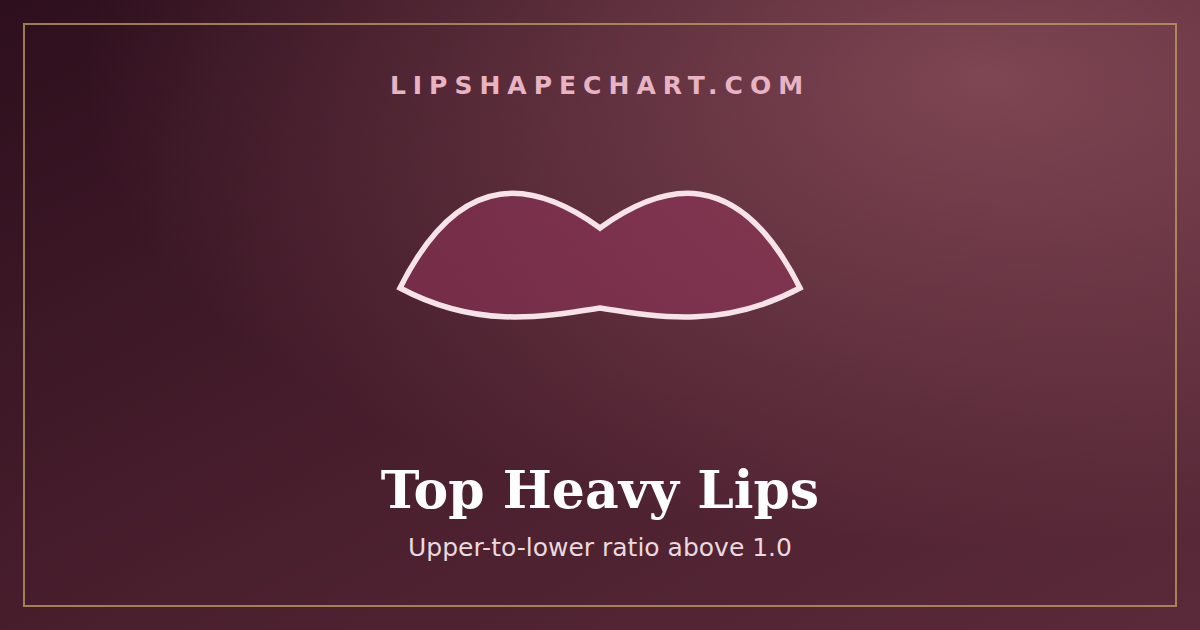
Most people check their Cupid’s bow first and their proportions second, which is exactly how top-heavy lips get missed. A mouth can have a soft, almost flat bow and still be clearly top-heavy, because the giveaway is height, not shape at the centre.
That distinction matters for everything that follows, from lip liner placement to choosing a finish. Once you measure the red lip correctly, top-heavy lips are one of the simplest patterns to spot and one of the easiest to balance with makeup.
Quick answer
Top-heavy lips are lips where the upper lip is visibly taller than the lower lip, with an upper-to-lower ratio above about 1.0.
In practice, that means the upper lip carries more height and more visual weight than the lower lip when the mouth is relaxed and closed. Most mouths sit the other way round, with a ratio of 0.6 to 0.9 and a taller lower lip.
Key takeaways
- Top-heavy means the upper lip is taller than the lower lip, with an upper-to-lower ratio above about 1.0.
- Most people have a ratio of 0.6 to 0.9, so a taller lower lip is the more common pattern.
- Only the red vermilion counts when you measure, not the skin between the lip and the nose.
- A defined Cupid’s bow alone does not make lips top-heavy, and a tall upper lip alone does not make them heart-shaped.
- Makeup balances top-heavy lips by keeping the upper lip calmer and giving the lower lip the lighter, glossier finish.
What top-heavy lips are
Top-heavy lips are defined by one comparison: the upper lip is visibly taller than the lower lip from top border to bottom border. It is a proportion label, not a size label, so top-heavy lips can be full, thin or anywhere in between. A small mouth can be top-heavy, and a large mouth can be perfectly balanced.
The ratio behind the label compares the height of the upper lip with the height of the lower lip. A ratio of 0.6 to 0.9 is most common, which means the lower lip is usually the taller of the two. When the ratio rises above about 1.0, the upper lip has overtaken the lower lip and the mouth reads as top-heavy.
This is why top-heavy lips are described as the less common direction of imbalance. The opposite pattern, a much taller lower lip with a ratio below about 0.6, reads as bottom-heavy. You can see both patterns side by side in the full overview of types of lips, where proportion sits alongside width, fullness and bow shape.
Fullness is a separate measurement and should not be confused with balance. Fullness compares total lip height with mouth width, where 0.28 or below reads thin and 0.42 or above reads full.
How to identify top-heavy lips
Start with a relaxed mirror check in plain daylight, with your mouth closed gently and no smile pulling the corners. Look at the red lip only and ask which half looks taller from its outer border to the centre line where the lips meet. If the upper half clearly wins that comparison, top-heavy is the likely reading.
Next, check the centre line rather than the fullest point of each lip. Upper and lower lips are rarely even across their width, and the lower lip is often fullest just off centre, which can mislead a quick glance.
Here is the common measuring error, stated plainly: judging the skin above the lip, up to the nose, instead of the red vermilion makes almost everyone read as top-heavy. That skin is not lip, and including it inflates the upper measurement for every face. Only the red lip counts, from the top border of the vermilion to the line where the lips meet, and from that line down to the bottom border for the lower lip.
For a measured result, the lip shape detector runs in your browser, uses 478 face landmarks and takes ten measurements in six families, with nothing uploaded. It reports the upper-to-lower ratio directly, so a result above about 1.0 confirms top-heavy rather than relying on a guess. It returns one of 9 shape labels plus a secondary trait, which helps when proportion is only part of the picture.
Top-heavy vs heart-shaped lips: the key difference
This is the mix-up that causes the most wrong labels, so it helps to separate the two traits completely. The ratio decides top-heavy, while the bow decides heart. One is about how tall the upper lip is compared with the lower lip, and the other is about the shape of the top border at the centre.
Heart-shaped lips, by the site rule, have a sharp angle at the centre of the upper lip. Bow-shaped lips are different again, with two rounded peaks rather than one sharp point. A Cupid’s bow depth above about 0.10 of total lip height reads as a defined bow, but depth and angle still say nothing on their own about upper-to-lower height.
That means a pronounced Cupid’s bow on a balanced mouth is heart, not top-heavy. If the upper and lower lips are similar in height, or the lower lip is taller, a sharp centre angle gives you the heart label regardless of how dramatic the bow looks. Calling that mouth top-heavy would be using the wrong test, because the ratio has not crossed 1.0.
The reverse case is just as common and just as often missed. A tall upper lip with a soft, flat bow is top-heavy, not heart, because there is no sharp centre angle to support the heart label. The upper lip can be taller than the lower lip without any sharp bow at all, which is why bow shape should never be used as a shortcut for proportion.
The two traits are independent and can combine in the same mouth. The dedicated guide to heart-shaped lips covers the bow side of the pairing in detail if your centre angle is the stronger trait.
If you are still unsure which label fits, compare your result with the visual lip shape chart and check the two tests separately. First ask whether the upper lip is taller, then ask whether the centre has a sharp angle.
What else combines with top-heavy lips
Top-heavy is a primary label about proportion, but most mouths carry a second trait that changes how they look and how they should be styled. The detector reflects this by reporting a primary label plus a secondary trait, rather than forcing every mouth into a single word. That second trait is often the detail people noticed first, even when proportion is the deciding feature.
Top-heavy with a defined bow is the combination most often confused with heart-shaped lips. The upper lip is taller and the bow is clear, with a depth above about 0.10 of total lip height, so both readings have some truth in them. The primary label still follows the ratio, while the bow is reported as the secondary trait.
Top-heavy and full is another clear combination, where the fullness ratio reaches 0.42 or above at the same time as the upper lip leads on height. This pattern carries a lot of visual weight in the upper half of the mouth, so finish and liner choices matter more than added volume. By contrast, top-heavy and thin lips, where fullness sits at 0.28 or below, look lighter overall even though the imbalance is the same, as the guides to full lips and thin lips show from opposite ends.
Width can combine with top-heavy too, giving top-heavy and wide lips where the mouth stretches further across the face. Width does not change the height ratio, but it spreads the upper lip’s weight over a broader area and softens the effect.
Makeup and finish for top-heavy lips
The aim with makeup is simple: balance the visual weight downward so the lower lip holds its own. You are not trying to shrink the upper lip or hide it, only to stop it dominating by default. Small changes to finish and highlight usually do more than heavy liner or strong colour contrasts.
Keep the upper lip in a matte or satin finish and give the lower lip the lighter or glossier treatment. Gloss and light catch the eye, so placing them on the lower lip draws attention to the shorter half and evens out the balance. A deep matte shade on both lips, by contrast, tends to underline the upper lip’s lead because the larger area carries the stronger colour.
Line the upper lip on its natural border rather than overlining it, because adding even a millimetre above the border increases the very height you are balancing. The lower lip can take a liner right on its border, or a touch of highlight placed at its centre, without changing its real shape. Let the lower lip carry the highlight, whether that is a lighter centre shade, a gloss dab or a soft sheen, and keep the upper lip’s centre calmer.
The mirror-image logic applies to bottom-heavy lips, where the upper lip carries the lighter finish instead. For top-heavy lips, calm on top and light below remains the reliable rule.
FAQs
Are top-heavy lips uncommon?
Yes, top-heavy lips are the less common direction of imbalance. Most mouths have an upper-to-lower ratio of 0.6 to 0.9, which means the lower lip is taller. A ratio above about 1.0 reverses that pattern, so fewer people fall into the top-heavy group. Uncommon does not mean unusual looking, and many top-heavy mouths read simply as strong or defined.
Does a defined Cupid’s bow mean my lips are top-heavy?
No, a defined Cupid’s bow on its own does not mean your lips are top-heavy. The bow describes the shape of the upper lip’s top border, while top-heavy describes its height compared with the lower lip. A sharp centre angle on a balanced mouth points to heart-shaped lips instead. Only the ratio, above about 1.0, decides the top-heavy label.
Why do I look top-heavy when I measure from a photo?
The most likely reason is that you measured the skin above the lip as well as the lip itself. Only the red vermilion counts, from its top border to the centre line where the lips meet. Including the skin up to the nose inflates the upper measurement and makes almost everyone read as top-heavy. Re-measure using the red lip alone and the result often changes completely.
Can top-heavy lips also be full or thin?
Yes, top-heavy lips can be full, thin or in between. Top-heavy describes the balance between the upper and lower lip, while fullness compares total lip height with mouth width. A fullness ratio of 0.42 or above reads full and 0.28 or below reads thin, independently of the upper-to-lower ratio. That is why the detector reports a primary label plus a secondary trait.
How does the detector decide if lips are top-heavy?
The detector decides from the upper-to-lower ratio, with a reading above about 1.0 counting as top-heavy. It runs in the browser using 478 face landmarks, takes ten measurements in six families and uploads nothing. Alongside the ratio, it checks fullness, width and bow depth before returning one of 9 shape labels. That measured approach avoids the two common errors of judging by bow shape alone or including skin above the lip.