
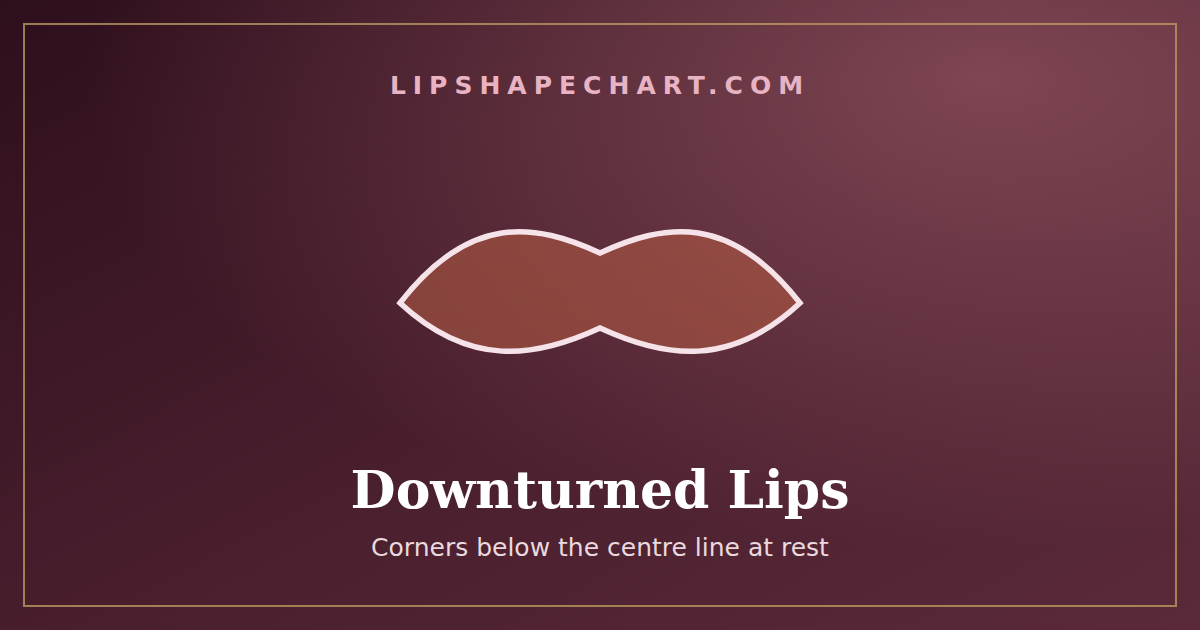
You have seen the photo: everyone else is mid-laugh, you felt perfectly fine, and yet your face is the one that looks annoyed. Friends ask if you are upset at rest. Strangers read a mood that is not there. In most of these cases the culprit is not your expression at all, but the direction your mouth corners point when your face switches off.
Downturned lips are one of the smallest measurements on this site and one of the most searched, because the gap between how you feel and how you look is frustrating. This guide covers how to check yours properly, how makeup changes the reading, and what clinics offer for the corners, with the risks stated plainly.
Quick answer
Downturned lips are lips whose corners sit below the centre line of the mouth when the face is completely at rest.
It is a trait, not a complete shape. Corner direction is independent of volume and balance, so downturned can be added to almost any other result: full lips with a downturned trait, thin lips with a downturned trait, and so on.
Because a tilted head can fake the reading, the check has to be done level and done twice. A corner that only looks low in one selfie is usually a camera problem, not a lip shape.
Key takeaways
- The test is the corners against the centre line of the mouth, on a fully relaxed face.
- Downturned is a secondary trait that combines with any volume or balance shape.
- Head tilt is the main false positive. Level the eye line and check twice before believing a result.
- One low corner on its own points to uneven lips, which is a different trait with different checks.
- Makeup cannot move a corner, but liner placement and cleaning up the shadow under the corner change how low it reads.
- Clinics offer Botox to the muscle that pulls the corners down and filler support at the corner. Both are temporary, both carry real risks, and this site recommends neither.
What downturned lips actually are
Every mouth has corners, and every corner sits somewhere relative to the line where the lips meet. On a downturned mouth, both corners rest below that centre line, so the mouth’s resting outline slopes gently downwards at the ends. The effect is out of proportion to the measurement: a drop of a few millimetres is enough to change the expression a face seems to wear.
Corner direction is one of the four independent traits this site measures, alongside volume, balance and width against height. The full trait system is set out in Types of Lips, where downturned sits in the contour family with the Cupid’s bow. That independence is worth understanding, because it means no amount of fullness or colour changes the trait itself; it only changes how strongly the trait shows.
It is also a trait most people share to a mild degree. Tiredness and a relaxed jaw let the corners sit lower than they do in the morning, which is why the honest check is done rested, level and at rest.
How to check yours at rest
The mirror check
Stand in daylight with the mirror at eye level, relax your jaw, and let your mouth close without pressing the lips together. Imagine a straight line running through the point where your lips meet at the centre, extended out to each side. If both corners finish clearly below that line, the downturned trait is there.
The relaxed part is where most checks fail. Pressing the lips together pulls the corners in and down, and a polite half-smile lifts them, so either state hides the answer. Think of the face you have when you are reading something dull, and check that one.
The photo check
A level photo is more reliable than a mirror, because it freezes the resting face and lets you draw the centre line properly. Take it straight-on, with the camera at eye level rather than above or below, and compare the corners against the centre line on screen. If you want the measurement done for you, the lip shape detector reads corner height from one photo in your browser, using 478 face landmarks and ten measurements in six families, and nothing is uploaded.
The printable lip shape chart helps too: its downturned cell is drawn with the corners visibly below the centre line, so you can compare the slope of your outline against it.
The head-tilt trap
More downturned results are caused by head position than by lips. Drop your chin slightly and every corner in the photo slides downwards relative to the centre of the mouth. Raise the camera above eye level and the same thing happens from the other direction. The site rule exists for a reason: corners below the centre line count as downturned, head tilt can fake it, so check twice.
The fix is to level the eye line first. In a photo, the line through the pupils should be horizontal before you judge anything below it. If the eye line is level and the corners still sit low in two separate photos taken on different days, the trait is real. If they only sit low when you are tired or photographed from above, you are measuring posture.
Selfies deserve special suspicion. A front camera held close and low exaggerates the lower face and drags the corners with it, which is why so many people meet their “downturned lips” for the first time in a phone photo and cannot find them in a bathroom mirror.
Downturned, or just uneven?
If only one corner sits low, that is not the downturned trait. It points to uneven lips instead, where the two sides of the mouth differ in height, corner position or both. The checks and the makeup approach differ, so the distinction matters, and it is covered in full in the guide to uneven lips.
Perfect symmetry is rare, and a left-to-right match of 90 percent or above is normal on this site’s measurements. Small differences between corners are the human default. The downturned label is about both corners travelling in the same downward direction, not about one side misbehaving.
Makeup that lifts the look of the corners
Makeup cannot move a corner, and any product that claims otherwise is selling you something. What makeup can do is change where the eye thinks the corner ends, and remove the shadow that makes a low corner look lower. Used together, the three techniques below are the standard correction for this shape.
Stop the liner before the corner
The common mistake is lining faithfully into the downturn, which draws a dark line pointing down and underlines the very thing you want to soften. Instead, stop the liner and the lipstick a fraction short of the natural corner, and angle the final stroke very slightly upward. The eye completes the line where it expects the corner to be, which is higher than where it is.
Keep the effect subtle. A corner redrawn too high or too far out reads as costume makeup in daylight, and the correction only needs a millimetre or two to change the expression.
Clean up the shadow under the corner
A downturned corner usually sits in a small fold, and the fold casts a shadow that deepens the droop. A touch of concealer or foundation blended under the outer corner removes that shadow, and the corner immediately reads lighter and higher. This is the highest-value step in the whole routine and the one most people have never been shown.
Set the concealer properly, because the corner moves all day and an unset product gathers in the fold by lunchtime. A fine powder pressed in lightly keeps the correction in place without adding texture.
Keep colour and gloss in the centre
Dark, matte colour carried right into the corners adds weight exactly where the mouth already drops. A satin finish through the centre of the lips, with the corners left softer and lighter, pulls the eye to the middle of the mouth instead. Gloss, if you wear it, belongs in the centre for the same reason. The corners should be the quietest part of the whole application.
What clinics offer for downturned corners
Searches for this shape carry a lot of treatment intent, so this section sets out what is actually offered, in plain terms. It is information, not advice. This site sells nothing and recommends no treatments, and nothing here is a promise that any procedure will change your corners or how they read.
Botox to the muscle that pulls the corners down
A muscle called the depressor anguli oris pulls the corners of the mouth downwards, and it is part of normal expression. Clinics inject small amounts of botulinum toxin into this muscle to relax it, so the downward pull weakens and the corners rest where the lifting muscles leave them. It is sometimes called a DAO Botox treatment.
Any effect is temporary. The toxin wears off gradually, and in general terms the result lasts a few months rather than anything permanent, after which the muscle returns to normal strength. The risks are real: because the muscles around the mouth work as a team, weakening one can change the smile, produce an uneven result if the two sides respond differently, or affect nearby mouth movements. Results vary, and only an in-person assessment can say whether a clinic considers you a candidate.
Filler support at the corner
The other common offer is a small amount of hyaluronic acid filler placed at or just below the corner, intended to support the tissue so the corner sits on a firmer base. Filler is also temporary, although timelines vary by product and placement, and it is sometimes combined with the muscle treatment above.
The risk list is different from Botox and should not be skimmed. Filler can form lumps, sit unevenly, or move from where it was placed, a problem known as migration. Bruising and swelling are common in the short term. Rare but serious complications exist with any filler, including blocked blood vessels, which is why the experience of the person injecting matters more than the price of the appointment.
Why this page recommends neither
Both options are temporary, both involve structures that move every time you speak or smile, and both can trade a mild trait for a new problem if they go wrong. For a trait that makeup handles well, that trade deserves slow thinking. If you do explore it, use a qualified medical practitioner, ask what happens if the result is uneven, and be wary of anyone who guarantees an outcome.
One safety point stands apart from cosmetics. A mouth that has been downturned on both sides for as long as you can remember is a shape trait. A droop that appears suddenly, or on one side only, is a medical matter, and it should be checked by a doctor promptly rather than researched as a beauty question.
FAQs
Are downturned lips the same as uneven lips?
No. Downturned means both corners sit below the centre line of the mouth at rest.
Uneven means the two sides differ from each other, which can include one corner sitting lower than the other. A mouth can carry either trait or both, and the detector reports them separately because the checks are different.
Why do my corners look downturned in photos but fine in the mirror?
Head tilt and camera angle are the usual cause, and they fake the reading in a large share of photos.
A chin dropped slightly, or a camera held above or below eye level, slides the corners down relative to the centre line. Level the eye line, take the photo straight-on, and check twice on different days before treating the trait as real.
Can makeup actually change downturned lips?
Makeup changes how low the corners read, not where the corners are.
Stopping liner just short of the corner, angling the last stroke slightly up and removing the shadow under the corner are enough to change the resting expression most people see. It washes off, which for a mild trait is usually the proportionate option.
How long does Botox for downturned corners last?
In general terms, a few months. The effect fades gradually as the muscle regains its normal strength.
Exact timelines vary between people and clinics, and repeat treatments are needed to maintain any result. This site recommends no treatments, so treat the question as one for a qualified practitioner who has assessed you in person.
Are downturned lips a sign of a medical problem?
A long-standing, both-sides downturn is a normal shape trait, not a diagnosis.
The exception is change. A droop that is new, sudden or one-sided only should be seen by a doctor promptly, because it can have medical causes that have nothing to do with lip shape.