
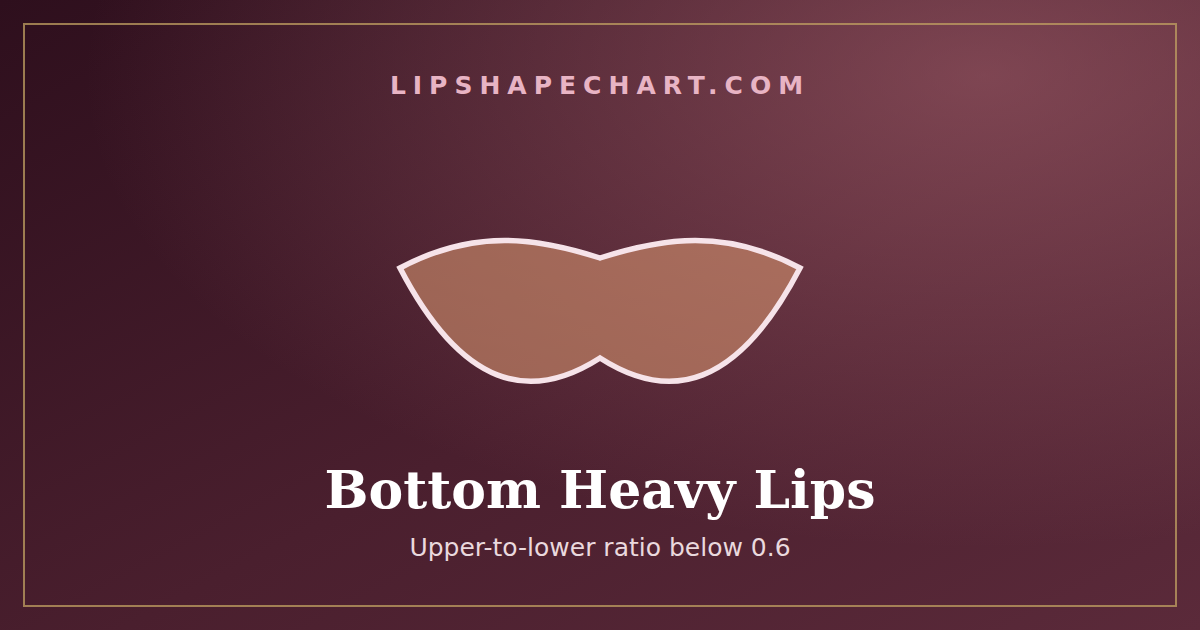
Take a straight-on photo of your relaxed mouth and look at where the light lands. On a bottom-heavy mouth it lands low: the lower lip catches the eye, carries the colour and does most of the visual work, while the upper lip sits quieter above it. Many people with this shape spend years thinking their lips are simply full, then wonder why makeup advice written for full lips never looks right on them.
The giveaway is balance, not size. Bottom-heavy lips are defined by where the height sits, and once you know the one ratio behind the label, you can check yours in under a minute and stop guessing from photos.
Quick answer
Bottom-heavy lips are lips where the lower lip is clearly taller than the upper lip, which gives an upper-to-lower ratio below about 0.6.
That ratio is measured at the centre of the mouth: the height of the upper lip divided by the height of the lower lip. A result from 0.6 to 0.9 is the most common pattern, and a result above about 1.0 flips the label to top-heavy instead.
Bottom-heavy is a balance trait, not a size category. It says nothing about whether your lips are full or thin, and it is one of the two shapes practitioners report seeing most often, alongside thin lips.
Key takeaways
- The deciding number is the upper-to-lower ratio: below about 0.6 reads as bottom-heavy.
- Balance and fullness are two separate measurements, so a mouth can be full and bottom-heavy at the same time.
- Thin and bottom-heavy are the most commonly reported shapes, based on practitioner observation. No study has counted lip shapes across a population.
- Always judge the ratio on a relaxed mouth in a level, straight-on photo. A smile or a tilted head changes the reading.
- Makeup balance comes from giving the upper lip the definition and the gloss, and keeping the lower lip quieter.
- The upper lip tends to lose height with age, so many adults drift further into bottom-heavy territory over time.
What bottom-heavy lips actually are
A bottom-heavy mouth carries most of its visible height in the lower lip. The lower lip shows a broad band of red tissue at rest, often with a soft highlight along its fullest point, while the upper lip is shorter from its border to where the lips meet. The Cupid’s bow can be sharp, soft or barely there, because bow shape is a separate trait that has nothing to do with balance.
The label is about proportion inside your own mouth, not about how your mouth compares with anyone else’s. A small mouth can be strongly bottom-heavy, and a wide, full mouth can be perfectly balanced. This is why the site treats balance as one of four independent traits, next to volume, width and contour, in the full breakdown of Types of Lips.
Most results are combinations. A typical reading is a primary shape plus a secondary trait, such as full with a bottom-heavy balance, and the combination is usually the more honest description of what you see in the mirror.
How to tell if your lips are bottom-heavy
The ratio check
Measure the height of the red part of your upper lip at the centre of your mouth, then do the same for the lower lip, and divide the upper number by the lower number. If the answer comes out below about 0.6, your balance reads as bottom-heavy. Between 0.6 and 0.9 is the most common range, and above about 1.0 the upper lip takes over and the label becomes top-heavy.
Use millimetres from a photo or a flexible tape against a mirror; the units do not matter because the ratio cancels them out. What matters is measuring the red tissue only. Including the skin between the nose and the upper lip border is the most common measuring error, and it makes almost everyone look less bottom-heavy than they are.
The mirror check
If numbers are not your thing, relax your mouth completely and look at which lip you notice first. On a bottom-heavy mouth the lower lip reads as the main event: it looks taller, it catches more light, and lipstick seems to disappear from the upper lip while staying obvious on the lower one. If both lips compete equally for attention, your balance is probably in the common middle range.
Do the check at rest, with no smile and no pout. Smiling stretches the upper lip thinner and can hide the very imbalance you are trying to see.
Let a photo measure it
A photo removes the guesswork, because software can measure the same points every time. The lip shape detector on this site works from one photo in your browser, takes ten measurements in six families from 478 face landmarks, and returns your shape with its secondary trait. Nothing is uploaded.
If you would rather compare by eye, the printable lip shape chart puts all 9 shapes at one scale, so you can hold your photo next to the bottom-heavy and full cells and see which outline your mouth follows.
Bottom-heavy or full? The mix-up almost everyone makes
This is the confusion that catches more people than any other on the site, and it comes from treating two different ratios as if they were one. Fullness and balance answer different questions. Fullness asks how much lip you have for your mouth width. Balance asks where that lip sits, top or bottom.
Fullness measures how much lip there is
The fullness ratio divides your total lip height, upper plus lower, by your mouth width. At 0.42 or above the mouth reads as full, and at 0.28 or below it reads as thin, whatever the balance is doing. The full lips guide covers that scale in full, and the thin lips guide covers the other end of it.
A bottom-heavy mouth often has a healthy total height, because the lower lip alone can carry the number over the full line. That is exactly how the mix-up happens: the fullness ratio says full, so the person stops there, even though the balance ratio is telling a second story underneath.
Balance measures where the lip sits
The upper-to-lower ratio ignores total size completely. Two mouths with identical fullness can sit at opposite ends of the balance scale, and they need different makeup, different liner placement and different expectations from a chart. Here is how the four combinations look in practice:
| Fullness | Balance | What you see |
|---|---|---|
| Full (0.42 or above) | Bottom-heavy (below 0.6) | A generous lower lip with a modest upper lip. The classic bottom-heavy look. |
| Full (0.42 or above) | Balanced (0.6 to 0.9) | Volume in both lips. This is the mouth most full-lip makeup advice is written for. |
| Thin (0.28 or below) | Bottom-heavy (below 0.6) | Low height overall, and what height there is sits low. Upper lip can look almost absent at rest. |
| Average (between 0.28 and 0.42) | Bottom-heavy (below 0.6) | Nothing extreme in size, but the lower lip still clearly leads. |
If your fullness lands in the full row and your balance lands in the bottom-heavy column, both labels are true at once. The detector reports this as a primary shape with a secondary trait, which is why its results often read like “full lips, bottom-heavy modifier” rather than a single word.
Makeup that balances bottom-heavy lips
The aim is not to make the lower lip smaller. It is to give the upper lip enough presence that the eye reads the mouth as a pair again. Almost every technique below works by adding definition or light to the top lip and taking emphasis away from the bottom one.
Put the definition on the upper lip
Line the upper lip on its natural border and take a moment over the Cupid’s bow, because a crisp bow is the fastest way to make an upper lip look intentional rather than missing. A satin or cream finish suits the upper lip here, since it holds a clean edge without the shine that inflates the lower lip further. If you overline anywhere, do it by a fraction on the upper lip only, and keep it believable.
Use gloss where you want the eye to go
Gloss magnifies whatever it sits on. A dab in the centre of the upper lip pulls attention upward and adds the impression of height where you want it. Keep the lower lip in a matte or soft satin finish instead, and blot it once after applying colour, because a glossy lower lip on a bottom-heavy mouth is the single quickest way to make the imbalance look stronger.
Keep the lower lip quieter
Avoid the habit of loading the lower lip with the darkest or shiniest product in the bag. If you wear a strong colour, keep the application even and let the liner work happen up top. A slightly deeper shade on the upper lip with a touch less intensity on the lower one reads as balance from normal conversation distance, even though nobody could spot the difference up close.
Bottom-heavy lips and getting older
If your balance has shifted over the years, you are not imagining it. The upper lip commonly loses height and lengthens as adults age, which means the same mouth that measured balanced at twenty-five can measure bottom-heavy at fifty. The lower lip changes less, so the ratio drifts downward even when the lower lip itself has not grown at all.
This drift is part of why bottom-heavy shows up so often in adult readings, and it is a normal pattern rather than a flaw to correct. The full picture of what changes, including corners, width and the bow, is covered in how lips change with age.
It also means a result is a snapshot, not a life sentence. If you measured yourself years ago, or you are comparing against an old photo, measure again before you rebuild a makeup routine around a balance you may no longer have.
FAQs
Are bottom-heavy lips the same as full lips?
No. Full describes how much lip height you have for your mouth width, while bottom-heavy describes where that height sits.
A mouth can be full and balanced, full and bottom-heavy, or thin and bottom-heavy. The two labels come from two different ratios, and most people need both to describe their mouth properly.
What ratio counts as bottom-heavy?
An upper-to-lower ratio below about 0.6, measured at the centre of the mouth using the red tissue only.
The range from 0.6 to 0.9 is the most common, and above about 1.0 the balance tips the other way into top-heavy. Borderline readings around 0.6 are normal, and the secondary trait in a detector result usually captures them.
Are bottom-heavy lips common?
Yes. Bottom-heavy is one of the two most commonly reported shapes, alongside thin lips.
That ranking comes from practitioner observation rather than a population study, because no study has counted lip shapes across the general public. Treat it as a well-informed impression, not a statistic.
Do bottom-heavy lips get more pronounced with age?
Often, yes. The upper lip tends to lose height as adults age, so the ratio falls even if the lower lip stays the same.
The change is gradual and varies a lot between people. If it matters to you, re-measure every few years instead of relying on an old result.
What lipstick suits bottom-heavy lips best?
A satin or cream lipstick with a properly lined upper border suits this shape best, with gloss kept to the centre of the upper lip.
The finish matters more than the shade family. Matte or blotted colour on the lower lip and definition up top will balance the mouth in almost any colour you already own.
Can bottom-heavy lips be changed?
Makeup changes how the balance reads, and it is the only route this site covers in any detail.
This site sells nothing and recommends no treatments, so it does not point you towards clinical options. Anyone considering a clinical route should treat it as a medical decision and discuss the risks with a qualified practitioner in person.