
Quick Answer
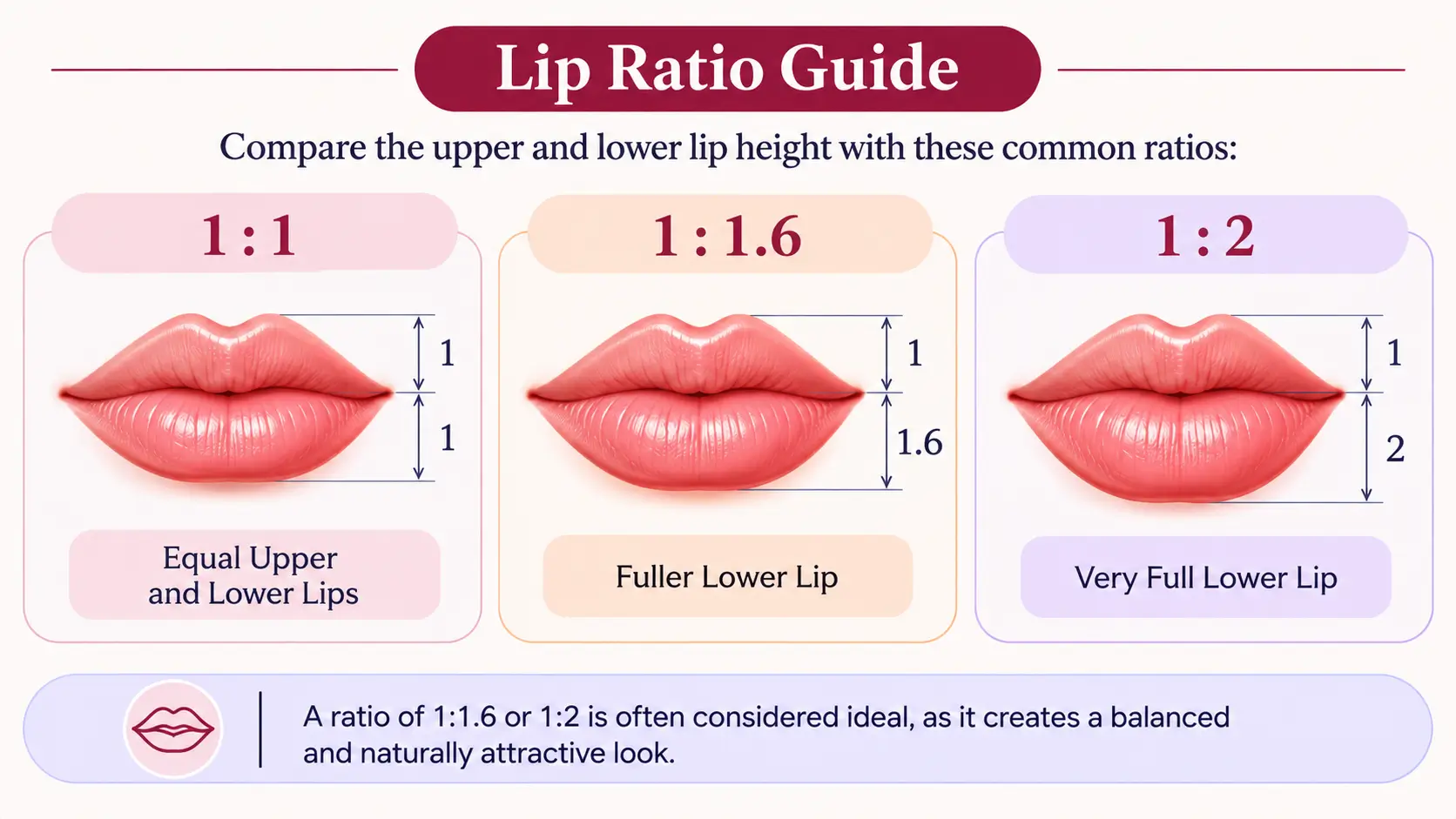
There is no single most attractive lip shape. The two studies quoted most often on this question reached different answers: a worldwide poll favoured an upper to lower lip ratio of 1:1, while a university rating study favoured a lower lip about twice the height of the upper, near 1:2.
What the research supports more consistently is proportion, not a named shape. Lips tend to read as attractive when they are in balance with the rest of the face, roughly symmetrical, and healthy looking, whatever category they fall into on a lip shape chart.
Key Takeaways
- No peer reviewed study has named one lip shape, such as full or heart-shaped, as the most attractive for everyone.
- The two famous ratio findings conflict: 1:1 in the 35-country poll, about 1:2 in the UC Irvine rating study.
- The widely quoted 1:1.6 figure is a convention borrowed from golden ratio writing, not the winning result of either study.
- Preferences shift with culture, sex, age, and fashion, and both lead researchers say so in their own papers.
- Symmetry, a defined border, and healthy looking lips influence ratings more reliably than the shape label.
Why You Keep Getting One Confident Answer
Most pages that answer this question sit on a clinic website. A clinic needs a target shape to sell a treatment toward, so a study finding becomes a headline, the headline becomes a recommendation, and the limits of the study quietly fall away.
This site sells no treatments, so it can show you the disagreement instead of hiding it. Two careful studies from the same year asked a similar question in different ways and did not agree, and that disagreement is the most honest answer available.
Study One: The Worldwide Poll That Favoured 1:1
In 2017, Paul Heidekrueger and colleagues published a survey in the Journal of Cranio-Maxillofacial Surgery. More than 9,000 plastic surgeons and laypeople were invited to take part, and 1,011 responses came back from 35 countries, a response rate of about 14 percent.
Participants used an interactive tool to adjust the lips of a single female model, changing the upper to lower lip ratio across a set range. Sixty percent of respondents chose the 1:1 ratio, where the upper and lower lips are about equal in height, as the most attractive option presented.
What this study can and cannot show
The strength of the poll is its spread: many countries, and a mix of surgeons and members of the public rather than one clinic’s patients. Its limits are just as clear, because respondents adjusted one model’s lips on a screen, which is a preference exercise and not a judgement of real faces in real life.
The authors themselves found that age, gender, country of residence, and profession all shifted what people preferred. Heidekrueger also cautioned that the result reflects current taste and may change over time, much like fashion, which is not how a fixed biological ideal would behave.
Study Two: The Rating Study That Favoured 1:2
Also in 2017, Natalie Popenko and colleagues at the University of California, Irvine, published a different kind of test in JAMA Facial Plastic Surgery. Instead of asking people to build their ideal lips, the team digitally morphed photographs and asked raters to score the results for attractiveness.
The highest rated images had about 50 percent more lip surface area than the original faces, measured precisely as a 53.5 percent increase. The preferred upper to lower lip ratio was about 1:2, the lips took up roughly 9.6 percent of the lower third of the face, and the top-heavy 2:1 ratio, where the upper lip is twice the lower, was rated least attractive.
What this study can and cannot show
The method was controlled and the rating process was systematic, which makes the internal comparison trustworthy. The external reach is narrow: the morphed images were based on young white women aged 18 to 25, so the result describes preferences about that group of faces and cannot simply be transferred to men, older faces, or other populations.
Digitally morphed images also remove everything that makes a real mouth attractive or not, including skin texture, movement, expression, and how the lips sit within a whole face. A ratio that wins on a screen of altered photographs is a finding about proportion preferences, not a verdict on anyone’s actual lips.
Why the Two Studies Conflict
The two teams measured different things. One asked a global mix of people to state a preference using an adjustable model, and the other asked raters to score altered photographs of a narrow group of young women.
Different questions, different faces, and different judges will often produce different winners, and neither team claimed to have settled the matter for everyone. When a clinic page quotes only the study that matches the treatment it sells, you are seeing marketing selection, not a scientific consensus.
| Study | Method | Sample | Preferred ratio | Main limit |
|---|---|---|---|---|
| Heidekrueger et al., 2017 | Interactive online survey | 1,011 respondents, 35 countries | 1:1 | One model, self-selected respondents, 14 percent response rate |
| Popenko et al., 2017 | Ratings of morphed images | Young white women aged 18 to 25 as the faces | About 1:2 | Narrow face sample, artificial images, no whole-face context |
The 1:1.6 Figure You See Everywhere
The ratio most often labelled the golden ratio for lips is 1:1.6, meaning the lower lip is about 1.6 times the height of the upper. It appears in textbooks, clinic guides, and review articles, usually described as a classic or conventional proportion for young Caucasian faces.
Its status is weaker than its reputation. The figure comes from golden ratio aesthetic writing and older anthropometric convention, and it was the winning result of neither of the two 2017 studies above, which landed on either side of it at 1:1 and 1:2.
Later reviews tend to describe a working range rather than one number, often around 1:1.3 to 1:1.7 for the populations studied. Treat 1:1.6 as a rough midpoint that many natural lips sit near, not as a target your lips pass or fail against.
How Preference Changes With Culture, Sex, and Age
Heidekrueger’s wider survey work found that geography and background moved preferences in measurable ways. Surgeons practising in Asia and non-Caucasian surgeons tended to prefer larger lips, European respondents and Caucasian surgeons tended to prefer smaller ones, and laypeople living in Asia preferred the smallest lips of the groups surveyed.
Sex and age matter too, because the faces being judged and the people judging them both vary. Most of the ratio research concerns young female faces, which means the evidence base says very little directly about men’s lips, even though men’s natural proportions differ and the same balance principles appear to apply.
Fashion adds a further layer that studies cannot freeze. Exposure to enlarged lips in media resets what viewers treat as normal, so a preference measured in one decade may partly record what that decade was looking at, rather than a permanent feature of human taste.
What Actually Reads as Attractive
If named shapes and single ratios do not decide attractiveness, what does the evidence point to instead? Four features recur across the research and across our own types of lips guide, and none of them requires a particular shape label.
Balance with the rest of the face
Lips are judged as part of a face, not in isolation. A mouth that suits the width of the nose, the jaw, and the lower third of the face tends to rate well at several different ratios, which is one reason the studies disagree: the winning ratio depends on the face carrying it.
Symmetry
Mild asymmetry is normal and present in almost every mouth, including the ones used to illustrate beauty articles. Larger left to right differences are more likely to draw the eye, and the lip shape detector reports a symmetry score for exactly this reason, alongside the ratios behind any label it gives you.
A defined vermilion border
The vermilion border is the edge where the coloured lip tissue meets the surrounding skin. A clear border reads as youthful and defined in rating studies and in ordinary perception, and it is also one of the features that softens with age, sun exposure, and smoking.
Healthy looking lips
Smooth, hydrated, evenly coloured lips signal health, and health signals are read quickly and positively by other people. Chapping, cracking, and persistent colour change pull attention for the opposite reason, and a persistent or one-sided change is a reason to see a doctor rather than a makeup question.
What First Impressions Research Adds
Psychology research on first impressions shows that viewers form judgements from lips and mouths within fractions of a second. Fuller lips on women are often read as warmer and more youthful, downturned corners are often misread as sadness or disapproval, and these snap judgements are consistent even when they are wrong about the person.
That distinction matters for how you use any of this. What other people assume from your lip shape is measurable and real in its effects, but it is a finding about perception, not about your character or your worth, a separation we keep throughout our guide to lip shape meaning.
So Which Shape Should You Want?
The practical answer is the one you already have, described accurately. Thin lips are the most commonly reported shape and sit comfortably inside every ratio range the studies produced, while heart-shaped lips are widely called the rarest and are not rated above other shapes by any study we can find.
If you are considering a cosmetic procedure, bring proportions to the consultation rather than a shape name copied from a celebrity photograph. Ask how a change would alter your upper to lower ratio and your balance with the rest of your face, and be cautious with any provider who promises one ideal ratio for every face.
If you simply want to work with your natural shape, makeup does more than ratio chasing ever will. Liner on your real border, gloss on the shorter lip, and colour kept in proportion to your features change how your lips read more reliably than pursuing a number from a morphed photograph study.
Frequently Asked Questions
What is the most attractive lip shape?
No single lip shape is the most attractive, according to the research. The two best known studies favoured different upper to lower ratios, 1:1 and about 1:2, and neither named a shape such as full, thin, or heart-shaped as a universal winner.
What is the ideal lip ratio?
There is no agreed ideal lip ratio. A 1:1 ratio won the 35-country Heidekrueger poll, a ratio near 1:2 won the Popenko rating study, and the commonly quoted 1:1.6 figure is a convention rather than a study result, so the honest summary is a range, roughly 1:1 to 1:2 depending on the face.
Are full lips more attractive than thin lips?
No, full lips are not automatically more attractive than thin lips. Popenko’s raters preferred more surface area on the specific young faces they were shown, but thin lips are the most commonly reported natural shape, and balance, symmetry, and lip health influence real world judgements more than volume alone.
What is the rarest lip shape?
Heart-shaped lips are widely described as the rarest lip shape. The claim rests on practitioner observation rather than a counted population study, because no large survey has ever counted how common each lip shape is, so treat any exact rarity percentage you see online as unsourced.
Do men and women find the same lip shape attractive?
No, preferences differ between groups of raters. The Heidekrueger survey found that age, gender, country of residence, and profession all shifted which ratio people chose, which is one reason a single worldwide ideal does not hold up.
Can I change my lip ratio?
Yes, your apparent ratio can be changed, temporarily with liner and gloss placement and longer term with cosmetic procedures. Any procedure decision belongs in a consultation about your own anatomy and proportions, not in a comparison with a study ratio, and this site gives styling guidance rather than treatment advice.
Sources
- Heidekrueger PI, Juran S, Szpalski C, et al. The current preferred female lip ratio. Journal of Cranio-Maxillofacial Surgery, 2017; 45(5): 655-660. DOI: 10.1016/j.jcms.2017.01.038, indexed on PubMed. The same survey’s cross-cultural findings were reported in Heidekrueger PI, et al. Lip attractiveness: a cross-cultural analysis. Aesthetic Surgery Journal, 2017; read that record on PubMed.
- Popenko NA, Tripathi PB, Devcic Z, et al. A quantitative approach to determining the ideal female lip aesthetic and its effect on facial attractiveness. JAMA Facial Plastic Surgery, 2017; 19(4): 261-267. Read the abstract on PubMed.
Both abstracts are free to read. Read the methods before quoting either result, because the limits described here come from the papers themselves.