
Quick answer
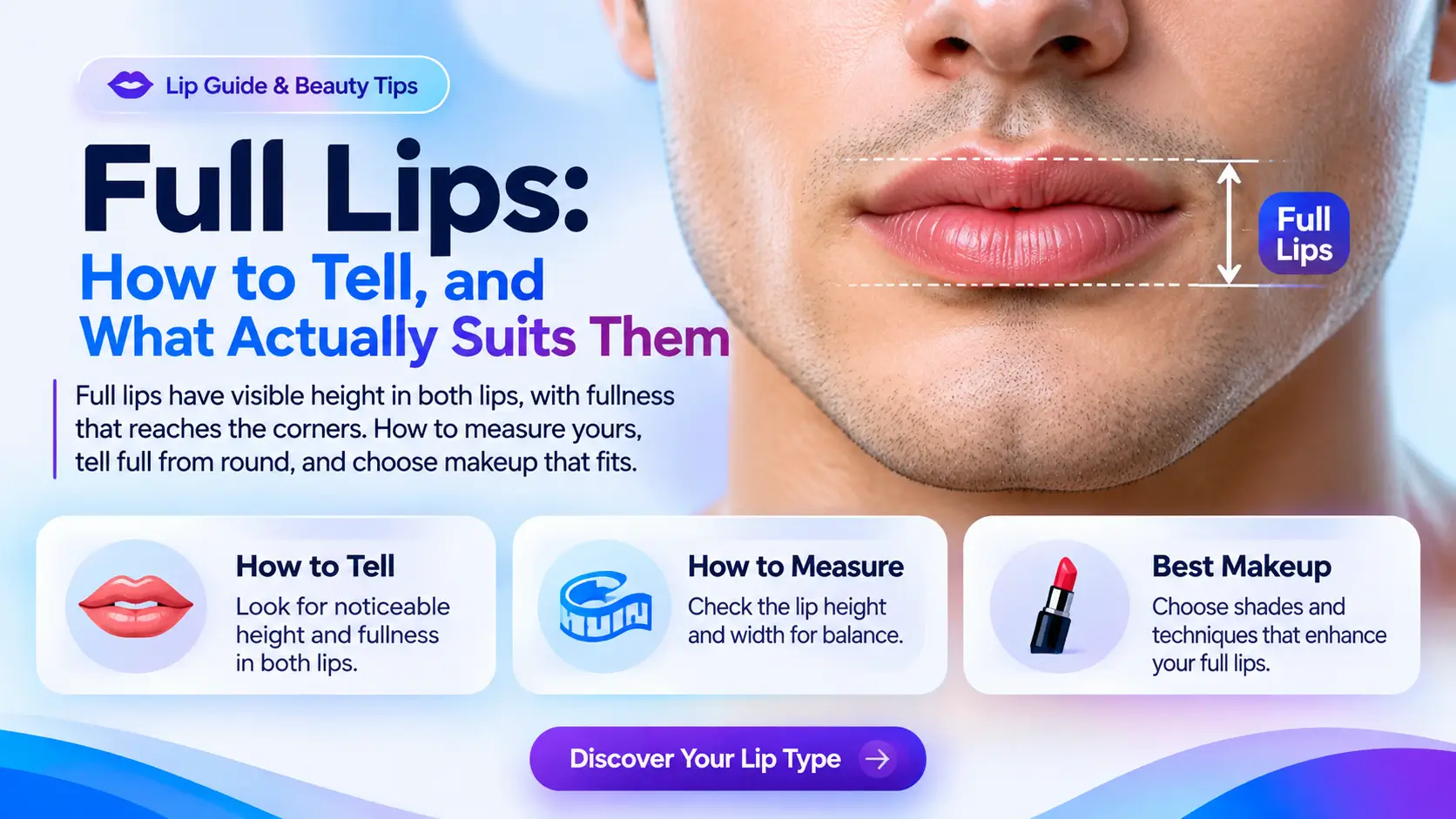
Full lips have noticeable visible height in both the upper and the lower lip, with fullness that continues out toward the corners. The working test on this site is a ratio: add the height of both lips and divide it by the width of your mouth. A result of 0.42 or above reads as full, and 0.28 or below reads as thin.
Most people are not one shape in isolation. Fullness is one trait among four, alongside upper to lower balance, width against height, and the shape of the Cupid’s bow and corners, so a result such as full and bottom-heavy is usually more accurate than the single word full.
Key takeaways
- Full describes height relative to width, not overall mouth size.
- The detector threshold used across this site is a fullness ratio of 0.42 or above; 0.28 or below reads as thin.
- Fullness reaches toward the corners, the clearest way to separate full lips from round lips.
- Thin and bottom-heavy are the most commonly reported shapes, based on practitioner observation. No study has counted lip shapes across a population.
- Makeup rule: line on the natural border, because overlining is rarely needed here.
- Filler on already full lips is a question of proportion, not volume. This site sells no treatments and recommends none.
What full lips actually are
A full mouth is defined by how much red tissue shows on both lips at rest. The upper lip has clear vertical height rather than a narrow strip, and the lower lip matches it with height of its own. Neither lip disappears into the other, and the mouth reads as present even with a completely relaxed face.
The second part of the definition is where the fullness sits. On full lips the volume is spread across the mouth, so the lips still show height well past the centre, toward the corners. That spread separates full from round, where the volume gathers in the middle and the mouth stays compact.
Fullness also says nothing on its own about balance. A full mouth can have lips of similar height, or a clearly fuller lower lip, which is the more usual pattern. If one lip dominates, that secondary trait will change your makeup choices more than the fullness does.
The anatomy terms behind the shape
- Vermilion: The red tissue of the lip itself. How much vermilion height shows, on both lips together, is what fullness measures.
- Vermilion border: The edge where the red tissue meets the skin. On full lips it is usually easy to see, so liner can follow it exactly instead of redrawing it.
- Cupid’s bow: The double curve at the top centre of the upper lip, two peaks with a dip between them. Full lips can have a sharp bow or a soft one, because the bow is separate from volume.
- Tubercles: The soft mounds of volume within a lip, typically one at the centre of the upper lip and two on the lower lip. On full lips they are spread across the lip rather than gathered in one spot.
- Oral commissures: The corners of the mouth. On full lips the vermilion keeps its height as it approaches them, instead of tapering away early.
- Philtrum: The groove between the nose and the upper lip. It is not part of the lip, and including it is the most common reason people overstate upper lip height.
If these terms are new to you, the lip shape chart shows all nine shapes side by side with the trait that defines each one. Seeing full placed next to thin and round explains the word faster than any definition.
Check Name Fonts and generate for yourself.
How to identify full lips in 60 seconds
You need a mirror, daylight, and a relaxed mouth. A photo works even better, because a mirror reverses your face and hides small side to side differences.
- Relax your mouth completely. Let your jaw hang loose, then close your lips without pressing them together. Pressing flattens the vermilion and makes any mouth read thinner, while smiling stretches the corners and thins the upper lip.
- Look at both lips, not one. Full requires height in both the upper and the lower lip. If only the lower lip carries the height, your primary shape is bottom-heavy instead.
- Follow the fullness to the corners. Ask whether the lips still show height two thirds of the way across, or whether only the centre looks full. Height reaching the corners points to full, and volume in the centre points to round.
- Check the ratio if you want a number. Measure the combined height of both lips at the centre and divide it by the width of your mouth. At 0.42 or above the mouth reads as full, at 0.28 or below as thin, and between those values the honest answer is medium.
- Name the second trait. Look at your Cupid’s bow, your corners, and which lip is taller. Most people are a blend of two shapes, so full and bow-shaped describes a mouth better than full alone.
If you would rather have the measuring done for you, the lip shape detector traces your lip outline from a photo in your browser and prints every ratio it used. The lip shape quiz scores the same traits from what you see in a mirror, with no photo needed.
Full lips vs round lips
This is the pair people mix up most often on this part of the chart. Both shapes have volume, so the difference is not how much lip you have, but where the mouth puts it.
| Check | Full lips | Round lips |
|---|---|---|
| Width against height | Clearly wider than tall | Height close to width |
| Where volume sits | Spread across the mouth, reaching toward the corners | Gathered in the centre |
| Corners | Vermilion keeps its height as it nears them | Outline tapers and curves in early |
| Overall outline | A wide, even band of red on both lips | A compact, circular outline |
| Best finish | Satin or cream | Any finish |
One quick test settles most cases. Compare the width of your mouth with the base of your nose. A mouth that reaches well past the nose and still shows height at the corners is full, while a mouth close to the nose width, with height near its width, is round.
The full side by side comparison of all nine shapes is in the guide to types of lips. It also covers the clinical sub types, such as gull wing and M-shaped lips, which sit on top of the nine main shapes rather than replacing them.
Makeup for full lips
The job on full lips is definition, not addition. Your mouth already shows its full height, so technique should keep the border clean and stop the shape reading as one block of colour. The guidance below matches the full lips approach in the site guide to lipstick for your lip shape.
Do this
- Line exactly on the vermilion border with a liner close to your natural lip colour. Your real edge is visible, so there is no need to invent one outside it.
- Use satin or cream finishes for everyday definition. They show the shape without adding apparent bulk.
- Keep gloss light and deliberate. A small amount at the centre of the lower lip is enough here.
- Balance the two lips with finish when one is fuller. Keep the fuller lip matte or satin and put gloss on the shorter lip.
Avoid this
- Overlining as a habit. Past the border, a drawn edge stops matching the shadow your real edge casts, and the extra outline shows quickly.
- Heavy gloss across both lips. Gloss enlarges whatever it covers, and on a full mouth it can overwhelm the lower face.
- Very dark colours without a defined border. Dark shades are a legitimate choice, but they need a clean edge or the shape blurs.
- Techniques built for thin lips. Advice for thin lips creates height that is not there, and a full mouth does not have that problem.
One more check is worth doing before you change anything. If your peaks are sharp and your lower lip is fullest at the centre, you may be closer to heart-shaped lips, where the rule is to trace the V and never fill the dip.
Full lips and filler
Full lips are the shape where the filler conversation needs the most care, because the starting point already has volume. Clinics describe results with target names such as Russian, keyhole and classic, and those names describe where volume is placed. They are technique vocabulary, not categories you belong to.
On a mouth that is already full, added volume changes proportion before it changes anything else. Upper to lower balance, width against height, and border definition all shift, so a small change can read as a large one. This site sells no treatments and recommends none, and whether a procedure suits you is a judgement only a qualified, regulated practitioner who has assessed you in person can make.
What the research on proportion actually says
The most cited study on lip proportion is Popenko and colleagues, published in JAMA Facial Plastic Surgery in 2017 and indexed on PubMed. Raters preferred faces with about 50 percent more lip surface area than baseline and an upper to lower ratio near 1 to 2. That finding is often quoted as proof that fuller is more attractive.
Read the method before using it that way. The images were digitally morphed rather than photographed, and the faces were young white women, so the result describes one narrow sample. Later reviews describe a working range of ratios rather than one ideal.
Full lips: frequently asked questions
What are full lips?
Full lips have noticeable height in both the upper and lower lip, spread toward the corners. The working test on this site is a fullness ratio of 0.42 or above, from dividing the combined height of both lips by the width of the mouth.
How do I know if my lips are full?
Relax your mouth in daylight and check whether both lips show real height that continues toward the corners. For a number, divide the combined height of both lips at the centre by your mouth width. A result of 0.42 or above reads as full.
Are full lips the most common lip shape?
No shape can honestly be called the most common, because nobody has counted lip shapes across a large population. Practitioners most often report thin and bottom-heavy lips, and both become more common with age.
What is the difference between full lips and round lips?
The difference is width and where the volume sits. Full lips are clearly wider than tall, with fullness reaching toward the corners. Round lips are compact, with height close to width and volume in the centre.
Can lips be full and another shape at the same time?
Yes, and most are. Fullness is one of four independent traits, so a mouth can be full and bottom-heavy, full and bow-shaped, or full with downturned corners.
What lipstick suits full lips best?
Satin and cream finishes suit full lips best for everyday wear. Line on your natural border rather than outside it, and use gloss sparingly, because gloss adds apparent volume. Very dark shades work when the border stays clean and defined.
Should full lips be overlined?
No, overlining is rarely needed on full lips. Your natural border is already visible, and a line past it stops matching the shadow your real edge casts. For more definition, sharpen the existing edge with liner and a fine brush.
Do full lips get thinner with age?
Yes, full lips lose volume with age like every other shape. The upper lip usually thins faster than the lower, so a full mouth often drifts toward full and bottom-heavy. Sun exposure and smoking speed the process up.
Is lip filler a good idea for full lips?
That cannot be answered on a website, because it depends on your proportions and anatomy. Filler on an already full mouth changes balance before size, so the useful first step is knowing your own ratios. Any decision belongs in an in person assessment with a qualified, regulated practitioner.
Keep reading
- Lip shape chart: all nine shapes side by side, with the detector that measures yours.
- Types of lips: every shape explained, with a comparison table.
- Thin lips: the opposite end of the fullness scale, and why its advice does not transfer.
- Lipstick for your lip shape: liner placement and finish for all nine shapes.
- Heart-shaped lips: the blend to check when your Cupid’s bow is sharp.
3 thoughts on “Full Lips: How to Tell, and What Actually Suits Them”